English
 العربية
 Nederlands
 Français
 Deutsch
 Italiano
 日本語
日本語 한국어
한국어 Polski
 Português
 Русский
 Español




Short answer: if your device generates heat, needs EMI compliance, or will work in an industrial or outdoor environment, an aluminum enclosure is almost always the right choice. If you are shipping a cost-critical consumer product at very high volume, plastic can win. For the great majority of B2B electronics projects — instruments, controllers, IoT gateways, audio gear, rack equipment — aluminum delivers a better balance of thermal performance, shielding, strength, tooling cost, and design flexibility. This guide compares both materials on the six criteria that actually drive enclosure decisions, with real products, pricing, and data you can use during specification.
Material Overview
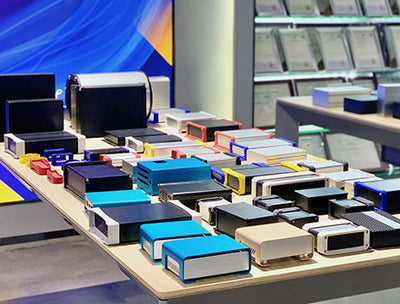
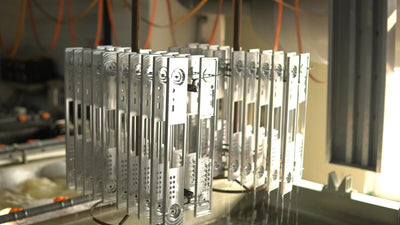
Aluminum enclosures are not one product — they are a family of processes. Extruded profiles (our aluminum enclosure line, including the H and J series) are cut from 6063 alloy and finished with aluminum or plastic end plates. Die-cast housings (T series) add pressure-tight sealing. Sheet-metal boxes (E/S series) cover large, low-cost builds, while CNC-machined enclosures handle tight tolerances and complex cutouts. Aluminum gives you one material with four production routes.

Plastic enclosures are typically injection-molded ABS or polycarbonate (PC). ABS is the budget workhorse; PC adds impact strength and better UL94 V-0 flame ratings. Plastics are electrically insulating, light, and cheap in very large quantities — but they are thermally insulating, transparent to EMI, and limited by mold tooling. Note that the two materials are not mutually exclusive: our K01 protective rail case combines an aluminum body with plastic end covers, and the L series offers the same IP68 box in an all-aluminum version and a plastic-cover version side by side.
| Property | 6063 Aluminum | ABS Plastic | Polycarbonate (PC) |
| Density (g/cm³) | 2.70 | 1.04–1.07 | 1.18–1.22 |
| Thermal conductivity (W/m·K) | ≈ 200 | ≈ 0.17 | ≈ 0.20 |
| Yield / tensile strength (MPa) | ≈ 145–160 | ≈ 40–45 | ≈ 60–70 |
| Electrical conductivity | Conductive (EMI shield) | Insulating | Insulating |
| UV / outdoor resistance | Excellent (anodized) | Poor without stabilizers | Fair with UV grade |
| Recyclability | ∞ (high scrap value) | Limited, down-cycling | Limited, down-cycling |
Typical values for base materials, standard published engineering data. Actual enclosure performance depends on wall thickness, alloy temper, and finish.
Side-by-Side Comparison Table
| Criterion | Aluminum Enclosure | Plastic Enclosure | Edge |
| Durability & impact | High strength, no shatter, corrosion-resistant | Good in PC, dents and UV-degrades in ABS | Aluminum |
| Heat dissipation | ≈1,000× better; passive cooling | Traps heat; needs vents or fans | Aluminum |
| EMI / RFI shielding | 60–90 dB with conductive joints | 0–5 dB; needs conductive coating | Aluminum |
| Weight | ~1.5–2.5× heavier than equivalent plastic | Lightest option | Plastic |
| Tooling cost | $500–$2,000 extrusion die | $8,000–$60,000 injection mold | Aluminum |
| Unit cost at scale | Moderate, stable | Lowest above ~30k units | Plastic |
| Customization speed | Cutouts, length, 9 anodizing colors — no new mold | Every change = mold rework | Aluminum |
Durability & Impact Resistance
A 6063-T5 aluminum extrusion yields at roughly 145–160 MPa — about four times the tensile strength of ABS. That difference shows up in the field: an aluminum housing takes a drop, a vibration load, or a tightening torque without cracking, while a thin-walled plastic box can shatter at the mounting boss or deform under panel-mount components. Aluminum also shrugs off UV and moisture when anodized, which is why outdoor, rail, marine, and industrial gear is specified in metal year after year.
Look at what strength buys you in practice: the H08 76W35H split enclosure and the one-piece J10 junction box carry extruded bodies with screwed end plates — stiff enough for DIN-rail, wall, or panel mounting, and reworkable if the design changes. Plastic is not useless here: polycarbonate is genuinely tough, which is why it is the plastic of choice for handheld and consumer enclosures. But PC costs more than ABS, and neither offers aluminum's combination of stiffness and corrosion resistance.
Thermal Conductivity & Heat

This is usually the deciding criterion. 6063 aluminum conducts heat at roughly 200 W/m·K; ABS and polycarbonate sit at about 0.17–0.20 W/m·K. That is a ≈1,000× difference — an aluminum housing turns the enclosure itself into a heatsink, spreading heat from the PCB, regulators, and amplifiers across the whole surface and radiating it away without a single fan.
Typical thermal conductivity (W/m·K) — log scale, each grid step ≈ 10×
6063 Aluminum — 200 W/m·K
Polycarbonate — 0.20 W/m·K
ABS — 0.17 W/m·K
Standard published material values. On a linear axis the plastic bars would be invisible (≈0.1% of the aluminum bar), which is exactly the point: plastic traps heat, aluminum moves it.
The engineering consequence: a power amplifier, LED driver, or industrial controller that runs warm in plastic needs vents and forced airflow, while the same board in an aluminum housing often runs passively. That is why our toothed side-panel aluminum heat-sink enclosures and the W-series amplifier chassis are specified for audio and high-power gear, and why the 19-inch rack enclosures used in server and telecom racks are almost universally metal. For a deeper dive into how housing materials behave under load, see our guide to the thermal knowledge of electronic housing materials.
EMI/RFI Shielding

If your product must pass EMC testing — and most electronics sold in the EU and North America must — enclosure material is a first-order decision. A bare aluminum housing with conductive joints delivers 60–90 dB of shielding effectiveness, attenuating both radiated emissions and incoming interference. Uncoated plastic attenuates essentially nothing: 0–5 dB. Plastic only joins the conversation when it is molded with conductive fillers or spray-coated, which adds cost and process risk.
Typical shielding effectiveness (dB) — higher is better
Uncoated plastic — 0–5 dB
Conductive-coated plastic — 40–60 dB
Anodized aluminum + conductive gaskets — 40–70 dB
Aluminum with conductive joints — 60–90 dB
Indicative ranges based on standard shielding-effectiveness data; actual values depend on frequency, joint design, and grounding.
One detail engineers often miss: anodizing is electrically insulating, so a fully anodized aluminum enclosure is not automatically a Faraday cage. The fix is simple and standard — mask the mating surfaces before anodizing, or fit conductive gaskets at the joints — and it is exactly the kind of design work we do in-house. If EMC is on your compliance list, start with our EMI-shielding enclosure collection — for example the K05A EMI-shielded enclosure or the K11C EMI/RFI shielding box — and read how EMI-shielded enclosures work before you lock the design.
Weight & Portability
Aluminum's density (2.70 g/cm³) is roughly 2.5× that of ABS and 2.3× that of polycarbonate. In practice the gap narrows because aluminum walls are thinner for the same stiffness — a typical aluminum enclosure ends up ~1.5–2.5× heavier than an equivalent plastic box, not 2.5×. For a bench instrument or a rack unit that difference is irrelevant; for a wearable or a drone payload it can be decisive. If grams are the spec, plastic — or a hybrid like the K series with its plastic end covers on an aluminum body — is the honest answer.
Cost & Tooling
Tooling is where the economics flip. An aluminum extrusion die costs $500–$2,000; an injection mold for a comparable plastic enclosure costs $8,000–$60,000 depending on cavity count and complexity. At low and medium volumes, aluminum is therefore cheaper overall — often dramatically. Plastic only takes the per-unit lead once mold cost is amortized over tens of thousands of pieces. The chart below gives planning-level figures for a small-to-mid enclosure; your real quote depends on size, cutouts, and finish.
| Volume | Plastic (injection) | Aluminum (extrusion) | Aluminum (die-cast) |
| Tooling (one-time) | $8k–$60k | $500–$2k | $10k–$50k |
| 100 units (unit cost) | $15–$60 | $8–$30 | $12–$40 |
| 1,000 units (unit cost) | $5–$20 | $6–$18 | $8–$25 |
| 10,000 units (unit cost) | $1.5–$6 | $4–$12 | $3–$10 |
| 100,000 units (unit cost) | $0.8–$3 | $3–$9 | $1.5–$5 |
Indicative planning ranges for a small-to-mid enclosure (typical tooling + piece price, excluding machining and cutouts). Plastics usually cross over to lowest total cost somewhere in the 10k–30k unit range.
There is also a lifecycle-cost argument that favors aluminum on paper before you even run volumes: aluminum has scrap value and is endlessly recyclable, while painted or filled plastics are usually down-cycled. And because we machine to order with no minimum order quantity — samples in 7–15 days, batch production in 15–30 days — you can validate a design in aluminum before committing any tooling budget at all.
Customization & Lead Time
An extruded aluminum profile is customized by cutting, milling, and finishing — not by new tooling. Cutouts for connectors, displays, and buttons, custom lengths, flanges, silk-screen or laser-engraved logos, and up to 9 anodizing colors are all day-one operations at our factory. When your panel layout changes after a prototype test, the cost of change is a drawing revision, not a mold modification. That iteration speed is why our custom enclosure service and custom-size enclosure option are the route most OEM/ODM projects take.
Plastic's customization story is the mirror image: complex one-piece geometries and snap-fit assembly are huge advantages if the design is frozen. Every change after molding means steel modification or a brand-new cavity. If your product is still evolving — which is true of most B2B electronics at spec stage — aluminum keeps your options open. (For a plain-language comparison of the two main aluminum processes, see extruded vs. die-cast aluminum enclosures.)
When to Choose Aluminum
Specify aluminum when two or more of these are true:
• Your board dissipates more than a few watts and you want to avoid fans or derating.
• You must pass EMC/EMI compliance (CE, FCC, RED) and want margin, not luck.
• The device lives outdoors, on a vehicle, on a DIN rail, or in a wash-down environment.
• Your volumes are below ~30,000 units per year — tooling cost alone justifies metal.
• You need custom sizes, cutouts, or branding, and you will iterate.
• The product is a professional instrument, amplifier, server, or controller where buyers expect a premium metal feel.
Real examples from our catalog: 19-inch rack enclosures for servers and telecom, energy-storage enclosures, IP68 outdoor boxes (the L01A aluminum version), and amplifier chassis. If one of these matches your application, send your drawing for a quote — request a quote and we'll respond within one working hour.
When to Choose Plastic
Plastic is the right call when:
• Volume is high (50,000+ units/year) and per-unit cost dominates the BOM.
• The product is a double-insulated handheld or consumer device where the enclosure must be non-conductive.
• Weight is a hard specification and the design is frozen.
• You need a complex one-piece shape (battery grips, living hinges, integrated bosses) that only molding can produce.
• A UL94 V-0 plastic meets the safety requirement and no EMI shielding is needed.
We still serve those projects: the L01B IP68 plastic-cover box is the same 100×75 mm size and IP rating as its aluminum sibling at a lower list price — a useful sanity check when you price the two materials side by side. And when neither extreme fits, hybrids (aluminum body, plastic covers, or vice versa) often give you 80% of both benefits.
FAQs
Is aluminum or plastic better for electronics enclosures?
It depends on heat, EMC, volume, and environment. Aluminum wins on heat dissipation, EMI shielding, durability, and low-volume economics; plastic wins on weight and per-unit cost at very high volumes. For most B2B and OEM projects, aluminum is the safer default.
Do aluminum enclosures block EMI?
Yes — typically 60–90 dB with conductive joints and proper grounding. Note that anodizing is insulating, so contact surfaces must be masked or fitted with conductive gaskets. Uncoated plastic provides essentially no shielding (0–5 dB). See our guide on how EMI-shielded enclosures work for the details.
Are aluminum enclosures much heavier than plastic?
Aluminum is ~2.5× denser, but thinner walls mean a real enclosure is only ~1.5–2.5× heavier than an equivalent plastic one. For rack, bench, and industrial gear it rarely matters; for wearables and flying payloads it does.
Why do aluminum enclosures cost more per unit?
Machining and material cost more than molded resin per piece. But the extrusion die costs $500–$2,000 versus $8,000–$60,000 for an injection mold, so below roughly 10,000–30,000 units aluminum is usually cheaper in total. Above that, plastic takes over.
Can aluminum enclosures be used outdoors?
Yes. Anodized aluminum resists UV and corrosion, and with O-ring or dispensed seals it reaches IP65/IP67/IP68. Our waterproof NEMA boxes and IP68 aluminum enclosures are built for exactly that duty.
Can I combine aluminum and plastic in one enclosure?
Frequently, and it is often the smartest option. The K series uses plastic end covers on an aluminum body — metal where you need heat and shielding, plastic where you need insulation and cost. Tell us your requirements and we'll recommend the mix.
Not sure which material fits your project?
Send us your drawing, power budget, and target volume. Our engineers will recommend the right material and process — and quote it — within one working hour.
Get Material Selection Advice →
Email: export@yonggu-enclosure.com · Phone/WhatsApp: +86 17708670860