English
 العربية
 Nederlands
 Français
 Deutsch
 Italiano
 日本語
 한국어
 Polski
 Português
 Русский
 Español





VPX is usually introduced as a connector and a pinout, which is only half the story. The connector defines how signals cross the backplane; it says nothing about how a module survives being bolted into a vehicle, sealed into an airborne enclosure, or conduction-cooled against a cold wall. That second half is VPX REDI — the mechanical layer that turns a plug-in card into a field-serviceable, thermally managed, shock-resistant unit. If you are designing the chassis rather than the module, REDI is the part of the standard that governs your drawings.
This introduction covers what REDI defines, how it relates to VPX and OpenVPX, the five mechanical functions it adds, which document in the family applies to which cooling scheme, and what a chassis has to provide for a REDI module to actually work.
VPX and REDI: Two Layers of One Architecture
The naming is dense, so it helps to separate the layers. VITA 46 is the VPX base standard: it defines the high-speed MultiGig connector, the 3U and 6U board form factors, the 1.0 inch slot pitch, and the mapping of legacy buses onto the new connector. ANSI/VITA 48.0-2022 is REDI — Ruggedized Enhanced Design Implementation — and defines the mechanical implementation for the plug-in modules themselves, including two module types and the structural and thermal features that make them durable in deployed systems (ANSI/VITA 48.0-2022, VITA).

| Layer | What it defines | What the chassis must provide |
|---|---|---|
| VITA 46 (VPX) | Connector, pinout, 3U/6U outline, 1.0 in pitch, 160 mm depth | Backplane, slot guides, panel apertures |
| VITA 48 (REDI) | Module mechanics: covers, thermal interface, wedge locks, increased pitch, two module types | Cold wall or airflow path, retention surfaces, keying, bonding |
| VITA 65 (OpenVPX) | System-level profiles: slot profiles, backplane topology, power and data fabric rules | A backplane and slot assignment that matches the profile |
The distinction matters commercially: a chassis can be mechanically REDI-compliant and still be wired to the wrong OpenVPX profile, or electrically correct and mechanically unable to hold a conduction module's wedge locks. Buyers should check both layers, and suppliers should state which one they are claiming.
The Module in Numbers
The base geometry is fixed and familiar. A 3U module is 100 mm high by 160 mm deep; a 6U module is 233.35 mm high by 160 mm deep. The classic slot pitch is 1.0 inch — 25.4 mm — which is enough for a board, its components, and an airflow gap in an air-cooled rack.
REDI changes that arithmetic. Both REDI module types take advantage of increased slot pitch, which buys room for thicker thermal planes, larger components and stronger structural features. The conduction standard adds a 100 mm module depth and additional pitches in 0.2 inch increments, so a designer can trade board area against thermal performance and mechanical stiffness within one architecture (ANSI/VITA 48.2-2022). In practice this is why a REDI chassis drawing cannot be derived from a VPX drawing by scaling: the pitches are a design variable, not a constant.
The Five Functions REDI Adds
REDI is easier to remember as five jobs it does for the module, each of which lands on the chassis drawing.
- Thermal interface. The module carries a thermal plane that spreads heat from the components to its edges, where a cold wall or an airflow path can take it. The chassis must present a mating surface at the right height and flatness, or the interface exists only on paper.
- Retention under vibration and shock. A wedge lock clamps the module edge against the chassis wall, providing both the thermal contact and the mechanical preload. The chassis needs a landing surface of adequate thickness, and the slot needs enough clearance for the lock to travel.
- Covers and ESD protection. REDI modules carry metal covers that protect the board and provide a defined ESD path. Type 1 modules support two-level maintenance — the field-replaceable unit is the covered module, not the bare card — which is the feature that makes deployed service practical.
- EMI and bonding control. The cover, the front panel and the chassis form the shield. Bonding has to be designed, not assumed: bare metal at the panel aperture, a gasket that survives repeated insertion, and a chassis finish that does not insulate the joint.
- Keying, alignment and connector retention. Modules must not go into the wrong slot, and the backplane connector must align reliably after hundreds of insertions. REDI defines the keying and the mechanical features that keep the connector engaged under load.

The REDI Family Map
VITA 48 is not one document but a family, and the cooling scheme decides which one governs your chassis. All titles below are as published by VITA in its VPX standards library (VITA VPX standards download page).
| Standard | Scope | Chassis feature it dictates |
|---|---|---|
| ANSI/VITA 48.0-2022 | REDI base: module types, mechanics, thermal intent | The common mechanical envelope for every scheme below |
| ANSI/VITA 48.1-2020 (R2026) | Air cooling | Slot pitch, airflow gaps, baffles or plenums, fans |
| ANSI/VITA 48.2-2022 | Conduction cooling, 3U and 6U, two-level maintenance | Cold wall flatness, wedge-lock landings, sealed interior |
| ANSI/VITA 48.4-2022 | Liquid flow-through cooling | Coolant manifold, quick disconnects, leak containment |
| ANSI/VITA 48.5-2026 | Modules using air flow-through cooling | Ducted module interiors, sealed chassis exterior |
| ANSI/VITA 48.7-2023 | Air Flow-By cooling | Air routed past modules rather than through them |
| ANSI/VITA 48.8-2022 | Air flow-through cooling at 1.0 to 1.5 inch pitches | Wider pitches and larger duct cross-sections |

A practical warning follows from this table: "REDI compliant" alone is an incomplete claim. A conduction chassis and an Air Flow-By chassis are both REDI machines, and neither accepts the other's modules. Ask which clause set the enclosure was designed to.
What a REDI-Compliant Chassis Must Do
The module is the standard's subject, but the chassis is where compliance is won or lost. Six requirements carry most of the risk.
- Slot pitch and guide tolerance. The pitch is chosen from the applicable clause, then held. A guide that drifts by a few tenths of a millimetre either refuses the module or leaves the wedge lock unable to reach its landing.
- Cold-wall flatness and thickness. For conduction, the wall is part of the thermal path. Flatness error creates an air gap exactly where the design is trying to avoid one, and thin walls deflect under wedge-lock load.
- Backplane alignment and connector float. Connectors need controlled float to mate without stubbing pins. Alignment is a chassis-and-backplane problem, not a module problem.
- Front panel apertures and bonding. The panel is part of the shield and part of the retention. Aperture dimensions, gasket compression and bare-metal contact all come from the same drawing.
- Insertion and extraction force. Lever-assisted insertion has to be provided for, and the chassis must react that force without distorting the slot.
- Corrosion and finish. Deployed REDI chassis live in salt fog, humidity and temperature cycling. An insulating coating applied over a bonding point quietly removes the shield.
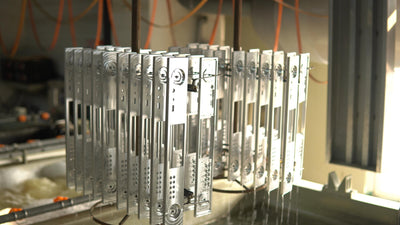
Two of these are machining decisions rather than assembly decisions: flatness and slot tolerance. That is why REDI chassis are milled from plate or machined from heavy extrusions rather than folded from sheet, and why the sealing and thermal surfaces are inspected with a CMM instead of a caliper.
Where REDI Chassis Are Used
REDI exists because two-level maintenance and conduction cooling are requirements of deployed military electronics, and the same mechanics then proved useful elsewhere: vetronics and airborne mission computers, rail signalling and traction control, industrial imaging and machine vision, and high-channel-count test systems where modules are swapped under load. In each case the driver is the same — a module that can be replaced in the field without opening it, inside an enclosure that manages heat without letting the environment in.
YONGU Rugged Aluminum Chassis
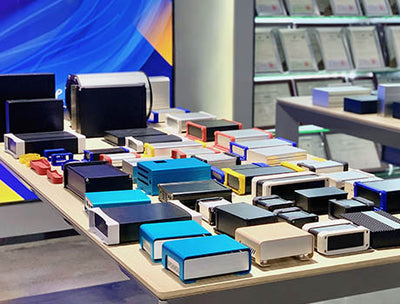
YONGU builds the enclosure side of this ecosystem: machined aluminum bodies with controlled wall flatness, consistent slot geometry and sealed construction. The 19-inch rack-mount chassis collection covers 1U to 4U enclosures in 6061 and 6063 aluminum, including the 2U chassis case and the 4U electronic enclosure; where a design needs a thermal mass rather than airflow, the 3U heat-sink rack chassis provides extruded fins on the body itself. REDI-specific slot guides, wedge-lock landings, keying and panel apertures are produced as custom work through the custom enclosure service, with tolerances and first-article inspection agreed at quotation on the request-for-quote page. Background on how the body material and sealing are chosen for deployed environments is covered in engineering a rugged industrial PC aluminum enclosure, and general questions are answered on the FAQ page.
VPX REDI FAQ
What does REDI stand for?
Ruggedized Enhanced Design Implementation. It is the mechanical half of the VPX architecture, published as the ANSI/VITA 48 family, and it defines how a module is cooled, retained, covered and keyed.
Is VPX REDI the same as OpenVPX?
No. REDI (VITA 48) is mechanical; OpenVPX (VITA 65) is the system-level profile set covering slot profiles, backplane topology and fabric assignment. A working system needs both.
Can a VPX module go into a REDI chassis from a different vendor?
It can, if the chassis was designed to the same clause of the REDI family and the same slot pitch. Modules from different cooling schemes — air versus conduction, for example — are not mechanically interchangeable.
Why does REDI increase the slot pitch?
Thicker thermal planes, larger components and stronger structural features need more room than the classic 1.0 inch pitch allows. The increased pitch is what buys thermal performance and durability.
What is two-level maintenance in this context?
The field-replaceable unit is the covered module rather than the bare circuit card, so a failed unit can be swapped in the field and repaired later at a depot. REDI's covers and ESD features exist to make that practical.
References
Standards and titles referenced from the VITA VPX standards library: ANSI/VITA 48.0-2022 (Mechanical Standard for VPX REDI), ANSI/VITA 48.1-2020 (R2026) Air Cooling, ANSI/VITA 48.2-2022 Conduction Cooling, ANSI/VITA 48.4-2022 Liquid Flow Through Cooling, ANSI/VITA 48.5-2026 Air Flow Through Cooling, ANSI/VITA 48.7-2023 Air Flow-By Cooling, ANSI/VITA 48.8-2022 Air Flow Through Cooling at 1.0 to 1.5 inch pitches, plus VITA 46 (VPX base) and ANSI/VITA 65.0-2025 (OpenVPX). The REDI acronym expansion follows VITA's own VPX overview. Chassis tolerances and inspection practice referenced above are published on yongucase.com.