English
 العربية
 Nederlands
 Français
 Deutsch
 Italiano
 日本語
日本語 한국어
한국어 Polski
 Português
 Русский
 Español




I recently finalized the mechanical validation for a heavy-duty edge computing project. Developing a reliable Industrial PC Aluminum Enclosure capable of surviving brutal factory conditions—intense vibration, conductive dust, and extreme thermal loads—is traditionally a nightmare for hardware engineers. Today, speaking from the perspective of an in-house designer at a professional Custom industrial PC aluminum enclosure manufacturer, I want to pull back the curtain on our latest design renders (see the attached images) to dissect the mechanical survival strategies we implement, and explain why standard sheet metal boxes fail miserably in these scenarios.
Defeating Impact Shearing: The Geometry of Recessed I/O Interfaces
Factory operators are not gentle with hardware. Equipment gets kicked, bumped by steel carts, and dropped during maintenance. If you look at standard industrial computers, the USB, DB9 cables, and power cords often stick straight out from a flat faceplate, making them prime targets for shearing forces.
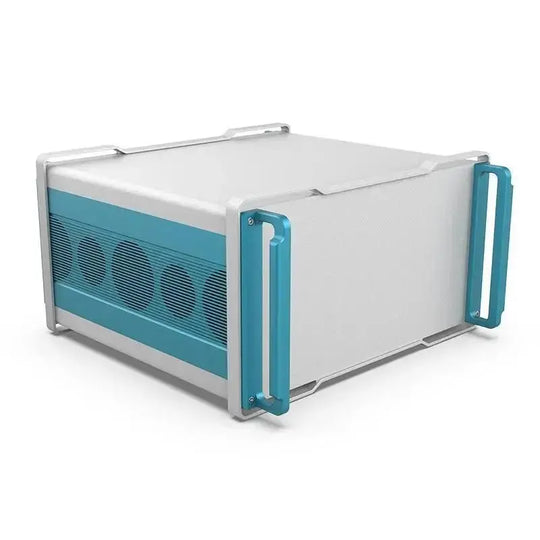
Observe the aggressive front and rear architecture of this chassis. We completely abandoned the traditional flat-face design. Instead, we engineered thick, angled aluminum bezels that deeply recess the main I/O plates. By pushing the dual USB ports, the RS232 serial ports, and the AC power input deep into the chassis profile, the plugged-in connectors are physically shielded by the metal overhang. Furthermore, look at those heavy-duty, die-cast blue handles mounted on the extreme outer edges. These are not merely ergonomic lifting points; they protrude past the main body, acting as primary structural roll-bars. If this unit takes a horizontal impact or is placed face-down on a concrete floor, the handles and the angled bezels absorb the shock, keeping the critical communication connectors entirely untouched.
Conquering Factory Dust: The Fanless industrial PC aluminum enclosure design Strategy
The second major cause of industrial hardware death is conductive dust and metallic shavings. Active cooling fans are basically vacuum cleaners that drag this debris directly across bare motherboard traces, inevitably causing catastrophic short circuits. Therefore, implementing a strict Fanless industrial PC aluminum enclosure design is an absolute non-negotiable requirement for edge computing.

Look at the striking blue side panels running the entire depth of the machine. These are not thin, stamped cosmetic plates; they are massive, deep-grooved aluminum extrusions. In this fanless architecture, these thick side walls act as a colossal passive heatsink. Internal copper blocks directly bridge the CPU to these extruded side panels, rapidly wicking thermal energy away from the silicon core and dissipating it into the ambient air through the high-surface-area external fins. We also added precisely CNC-milled slotted vents on the angled front and rear fascia. These are designed for localized acoustic transmission (like warning buzzers) or specific non-critical ambient breathing, structurally isolated to never compromise the sealed integrity of the main computing chamber.
Agile Sourcing: Defeating the Tooling Trap with Our In-House Structural Platform
When project managers see a highly stylized, dual-tone (silver and anodized blue) structural chassis like this, they usually panic. The assumption is that to achieve this level of mechanical integration and aesthetic presence, you need to write a six-figure check for custom aluminum extrusion dies and wait 12 weeks for a first article to be machined.
That is a massive misconception, provided you go directly to the source. As your dedicated Custom industrial PC aluminum enclosure manufacturer, we eliminate this barrier completely. For this specific build, we didn't force the client to reinvent the wheel from scratch. Instead, we built this entire skeletal concept around our proven, in-house YONGUCASE F08 Industry 4U PCB Custom Box platform.
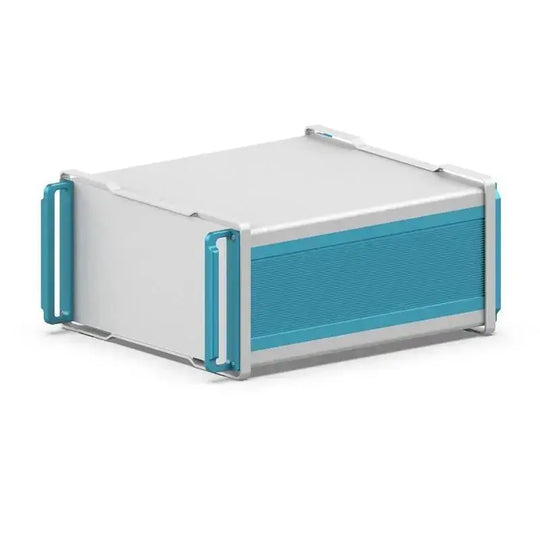
The core structural loop of this machine—the interlocking heavy-duty top and bottom silver panels, and those aggressive, heat-dissipating blue side extrusions—is entirely based on our off-the-shelf F08 modular system. By utilizing this ultra-rigid standard skeleton from our inventory, we bypass the expensive and agonizing mold-making process for your team. We then direct your entire mechanical R&D budget into high-impact functional customization: CNC machining those complex, angled front and rear faceplates, drilling ultra-precise cutouts for your specific industrial I/O, and applying the customized two-tone surface treatments. Leveraging our mature structural standard products combined with our deep in-house CNC capabilities is the smartest, leanest way to deploy flagship-tier industrial hardware without losing control of your timeline or budget.