English
 العربية
 Nederlands
 Français
 Deutsch
 Italiano
 日本語
日本語 한국어
한국어 Polski
 Português
 Русский
 Español




The long-term stability and peak processing performance of a custom server rely entirely on matching your internal hardware with the correct external architecture. Successfully deploying a system requires standardizing on an industry-compliant 19-inch format and prioritizing thermally conductive, rigid chassis materials that eliminate both heat throttling and structural sagging over the hardware's lifespan.
The Hidden Dangers of Custom Server Deployments
Whether you are setting up a home lab, building a high-frequency trading server, or deploying an edge-computing node in a factory, system builders face two primary adversaries: trapped ambient heat and mechanical stress. Unlike standard desktop tower PCs, a rackmount setup condenses massive amounts of processing power into a highly restrictive footprint.

When high-wattage CPUs, dense RAM banks, and enterprise-grade hard drives operate under load, the localized heat generation is immense. If a rackmount enclosure for server applications relies on poor airflow dynamics or heat-trapping materials, components will quickly thermal-throttle, cutting performance by up to 40% to save themselves from melting down. Additionally, heavy power supplies and storage arrays mounted inside cheap, thin steel cases can cause the enclosure to sag inside the server rack, misaligning sliding rails and making future maintenance an operational nightmare.
Sizing It Right: The Foundations of Rack Dimensions
The rackmount industry uses "Rack Units" (abbreviated as 'U' or 'RU') to define height. A standard rack is 19 inches wide, but the height dictates what hardware you can realistically fit inside your build. One Rack Unit (1U) equals exactly 1.75 inches (44.45mm). As you scale up to 2U, 3U, or 4U, your hardware options expand dramatically.

For example, 1U cases severely limit your cooling options—requiring low-profile CPU coolers and small, high-RPM (and very loud) 40mm fans. Standard ATX power supplies will not fit in a 1U or 2U case; you are forced to use specialized 1U or Flex ATX power supplies. If your build requires standard desktop-sized PCIe graphics cards or full-sized redundant power supplies, migrating to a 3U or 4U chassis is structurally mandatory.
Comprehensive 19 inch rack case selection guide
To assist your planning phase and prevent costly dimensional errors, refer to the sizing standard data table below when conceptualizing your next build:
| Unit Height (U) | Height in Inches (mm) | Motherboard Compatibility | Cooling Dynamics & Constraints | Ideal Application Scenario |
|---|---|---|---|---|
| 1U | 1.75" (44.45mm) | Mini-ITX, Micro-ATX | Requires 40mm fans and passive CPU blocks. High noise. | Firewalls, simple network switches, edge routers. |
| 2U | 3.50" (88.90mm) | Micro-ATX, ATX | Uses 80mm fans. Supports half-height PCIe cards. | Web hosting servers, NAS arrays, NVR security systems. |
| 3U | 5.25" (133.35mm) | ATX, E-ATX | Supports standard 120mm fans for quieter operation. | Audio/Video processing servers, telecom equipment. |
| 4U | 7.00" (177.80mm) | E-ATX, SSI-EEB | Fits large tower CPU coolers and full-size PCIe GPUs. | Deep learning AI rigs, massive data storage, rendering servers. |
Material Science: Overcoming the Thermal Challenge
A crucial factor frequently overlooked in rack building is the material of the case itself. Traditionally, cold-rolled steel has been the standard due to its cheap manufacturing cost. However, steel is extraordinarily heavy and acts as an insulator, retaining internal heat rather than dissipating it.
When deploying IT infrastructure in specialized application scenarios—such as professional audio studios that demand near-silent operation, or industrial automation sites (Edge IoT) exposed to dust where active cooling fans would quickly fail—passive cooling becomes essential.
This is exactly where upgrading to an aluminum rackmount chassis fundamentally changes your system design. Aluminum boasts a thermal conductivity rate significantly higher than steel. Instead of trapping heat, an aluminum shell rapidly draws thermal energy away from internal components and radiates it out into the surrounding air.
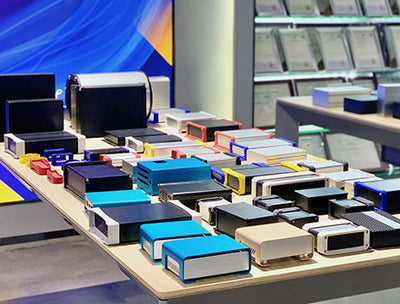
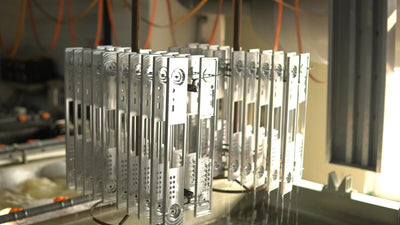
For custom engineering and high-end server builds, YONGU provides a distinct operational advantage with their precision-extruded enclosures. By incorporating heavy-duty heat-sink fins directly into the chassis wall design, YONGU effectively turns the entire server case into one massive passive cooler. This specialized heat-sink architecture eliminates the need for loud, failing internal fans, keeping ambient noise minimal and internal boards dust-free. Furthermore, YONGU's advanced CNC machining ensures that standard 19-inch mounting ears and internal motherboard standoffs align flawlessly right out of the box, offering system integrators a streamlined, highly aesthetic, and thermally superior mounting solution.
Frequently Asked Questions (FAQ)
1. Can I install a standard desktop motherboard in a 19-inch rack enclosure?
Yes. The 19-inch specification refers exclusively to the external width of the case meant for the server rack rails. Internally, most 2U, 3U, and 4U enclosures feature standardized mounting standoffs to support commercial Mini-ITX, Micro-ATX, and standard ATX motherboards.
2. Does aluminum offer better electromagnetic (EMI) shielding than steel?
Aluminum provides excellent EMI shielding and is often preferred in telecommunications and professional audio-visual racks. Unlike steel, it does not hold a magnetic charge and is highly effective at blocking radio frequency interference, ensuring clean signal paths for sensitive digital equipment.
3. Do I need sliding rails for my rackmount chassis?
If your chassis is a 1U network appliance weighing under 15 lbs, standard front rack ears are usually sufficient. However, for 2U to 4U servers filled with heavy power supplies and storage drives, using a dedicated sliding rail kit is mandatory to prevent the enclosure from snapping the front mounting screws and collapsing the rack.
Ready to Upgrade Your Server Architecture?
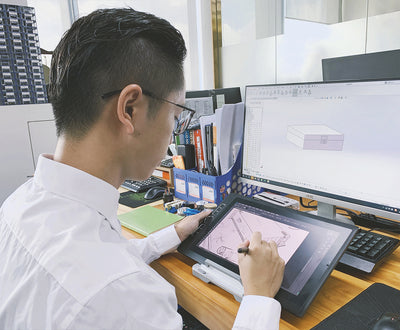
Don't let subpar casing bottleneck your expensive hardware. Whether you are designing silent studio equipment, rugged industrial edge nodes, or custom enterprise servers, specialized thermal management is key. Explore advanced extrusion and CNC capabilities to bring your build to life. Contact the YONGU engineering team today to discuss custom sizes, panel cutouts, and finding the perfect heat-dissipating chassis for your next critical project.