English
 العربية
 Nederlands
 Français
 Deutsch
 Italiano
 日本語
日本語 한국어
한국어 Polski
 Português
 Русский
 Español




Short answer: extrusion wins when you need low tooling cost, no minimum order, fast delivery and a clean anodized finish; die casting wins when you need complex 3D shapes and very large volumes. Most electronic projects start with an extruded aluminum enclosure because the die is inexpensive and the length is customizable, while a die-cast aluminum enclosure makes sense once geometry and quantity justify the mold. This guide compares both processes with real numbers on tooling, MOQ, strength, finish and lead time, so you can decide before you buy.

Extrusion Process Overview
Aluminum extrusion starts with a 6063 (or 6061/6005) billet heated to roughly 450–500 °C and forced through a steel die under high pressure, producing a profile with a constant cross-section. The extruded length is then cut to your exact dimension, heat-treated to T5/T6 temper for strength, and CNC-machined for end plates, cutouts and mounting features. Because the cross-section repeats along the full length, one die serves any number of enclosure lengths — a single profile can yield a 90 mm, 150 mm or 300 mm case.
Extrusion is the backbone of the YONGU line (H, J, G and K series are all extruded). A split extruded enclosure combines the profile body with two machined aluminum end plates; a one-piece extrusion adds internal PCB slots. The practical advantages: simple dies cost roughly $500–$2,500, tooling is ready in 1–2 weeks, and there is no minimum order — YONGU stocks standard profiles and ships the same day. For dimensioned planning, the aluminum extrusion enclosure collection lists the stock sizes, and the custom enclosure size service covers non-stock lengths and widths.
Die Casting Process Overview
Die casting injects molten aluminum alloy (typically ADC12/A380) into a hardened steel mold at high pressure, where it cools in seconds and reproduces the cavity in full 3D — walls, bosses, ribs, mounting lugs and even die-cast threads in one shot. That is what makes die casting unbeatable for complex enclosures: shapes that extrusion physically cannot produce, like curved housings, multi-plane flanges and thin-wall IP-rated boxes with integrated seal grooves.
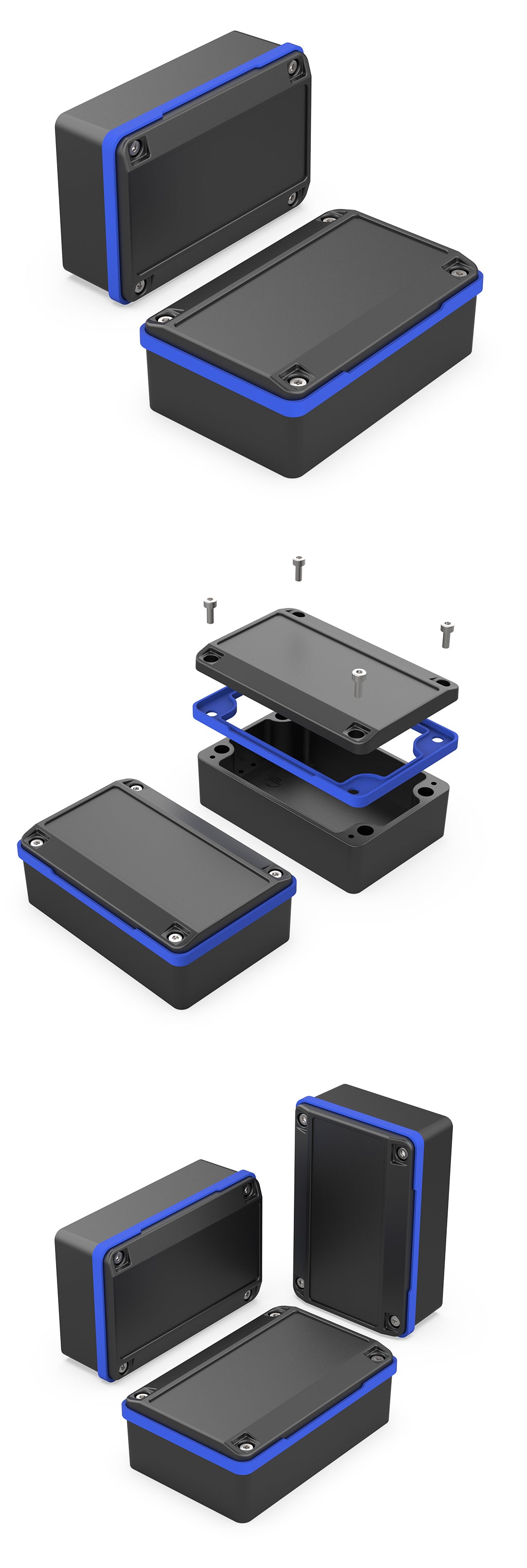
The cost of that freedom sits up front. A production die-cast mold runs roughly $5,000–$50,000+ depending on cavity count and complexity, tooling takes 4–8 weeks, and the economical run sizes are 1,000+ pieces. Die-cast parts also need post-casting machining on sealing faces and a paint/powder coat (the as-cast skin is hard but porous), which is why YONGU's die-cast products, such as the IP68 die-cast aluminum enclosure and the die-cast aluminum box, are ordered in quantity and stocked for repeat demand.
Side-by-Side Comparison
| Factor | Extrusion (6063) | Die Casting (ADC12/A380) |
| Geometry | Constant cross-section, any length | Complex 3D, thin walls, bosses, ribs |
| Tooling cost | ≈ $500–$2,500 | ≈ $5,000–$50,000+ |
| Tooling lead time | 1–2 weeks | 4–8 weeks |
| MOQ | 1 pc (NO MOQ) | ≈ 1,000+ pcs |
| Typical wall | 1.5–3 mm | 1–3 mm |
| Yield strength | ≈ 110–240 MPa (T5/T6) | ≈ 150–220 MPa (as-cast) |
| Density | ≈ 2.70 g/cm³ | ≈ 2.71 g/cm³ (with porosity) |
| Thermal conductivity | ≈ 201 W/m·K | ≈ 96 W/m·K |
| Anodized finish | Excellent, uniform oxide | Poor as-cast; machine + coat |
| Economical volume | 1–10,000 pcs | 5,000–100,000+ pcs |
Typical values from ASTM B221 (6063-T5/T6) and ASTM B85 (ADC12/A380); verify the specific temper and casting condition for your application.
Design Flexibility & Complexity
Extrusion limits you to a 2D profile extruded in a straight line — any detail must be uniform along the length, and complexity lives in the machined end plates. Die casting has no such constraint: walls, ribs, bosses, undercuts, logos and seal grooves are cast into the cavity, and thin walls down to ~1 mm are routine. If your design needs a curved body, a one-piece box with integrated mounting lugs, or a flameproof joint geometry, die casting is the only option; if a rectangular case with cutouts covers it, extrusion plus CNC is faster and cheaper.
Tooling Cost & MOQ
This is where the two processes diverge hardest. An extrusion die is a single steel plate with a shaped opening — $500–$2,500 and 1–2 weeks. A die-cast mold is a multi-plate tool with ejectors and slides — $5,000–$50,000+ and 4–8 weeks. Because extrusion tooling is cheap and profiles are stocked, YONGU ships extruded enclosures with NO MOQ; die casting only pays off when volume amortizes the mold. The cost-volume curves below show the crossover:
Relative unit cost vs. production volume (illustrative, tooling amortized)
10 pcs
1,000 pcs
10,000 pcs
50,000 pcs
Normalized against a 10-piece extruded run including tooling share; actual crossover depends on box size, machining and finishing — request a quote for your exact drawing.
Mechanical Strength
Neither process is weak, but the failure modes differ. Extruded 6063-T6 reaches roughly 240 MPa yield with good elongation — it bends before it breaks, which suits vibration and screw retention. Die-cast ADC12 delivers ~150–220 MPa as-cast with a fine-grained, high-strength skin, but the cast structure is more brittle and internal gas porosity can appear on machined faces. Microstructurally, extrusion produces a wrought, pore-free grain structure elongated along the profile axis (hence its uniform anodizing response and consistent machinability), while die casting solidifies as fine dendrites with dispersed micro-porosity — stronger in compression, more porous at the surface:
| Microstructure | Extrusion (wrought) | Die casting (cast) |
| Grain structure | Elongated, directionally oriented | Fine dendrites (equiaxed) |
| Porosity | Pore-free (wrought) | Micro-porosity common |
| Surface layer | Clean, machinable skin | Hard but porous skin |
| Ductility | Good (bends, resists cracking) | Lower (brittle in thin sections) |
Surface Finish Options
If you want a premium anodized finish, extrusion is the reliable path: the pore-free wrought surface anodizes evenly in silver, black, gold and custom colors, and it takes brushing or sandblasting beautifully. Die-cast parts anodize unevenly over their porous skin, so the standard treatment is machining the critical faces, then sandblasting and powder coating — great for color and texture, but not for a true metal finish. YONGU's surface treatment service covers anodizing, sandblasting, brushing and powder coating for both; see the principle of anodizing aluminum enclosures for the chemistry behind the difference.
Lead Time & Production Volume
Extrusion wins every early-stage timeline: stock profiles ship in 24 hours, custom samples in 8–10 days, and production in 15–30 days with no tooling wait if a profile exists. Die casting commits you to 4–8 weeks of tooling plus first-article sampling before the first batch, so realistic lead times run 6–12 weeks — acceptable when you have a locked design and a forecast of thousands of units. If your volume is under ~10,000 pieces, an extruded box with CNC machining is almost always the faster, cheaper start; you can migrate to die casting later if the design stabilizes and volumes grow. The CNC enclosure custom service bridges the gap with machined prototypes before any mold commitment.
When to Choose Extrusion
Choose extrusion when: your design is a rectangular or profile-based case; you need no MOQ or a fast first article; you want the length to stay adjustable for different PCB depths; or you want a clean anodized, brushed or sandblasted finish. This covers prototypes, pilot runs, OEM enclosures for routers, controllers, amplifiers and sensors, and any project where tooling budget is tight. It is the YONGU core strength — profiles stocked, samples in days, no minimum order — so most buyers start here. Browse the aluminum enclosure collection or request a quote with your cutout drawing.
When to Choose Die Casting
Choose die casting when the geometry cannot be extruded (curved bodies, multi-plane flanges, integrated bosses and seal grooves), when the design is frozen and volumes justify the mold, or when a one-piece cast structure gives you the strength and IP sealing you need in a single part. It is the right call for high-volume waterproof junction boxes, industrial housings and appliances at 5,000+ pieces per year, where the amortized unit cost beats extrusion. See the IP68 die-cast enclosure and die-cast IP68 junction box for production-ready examples.
Not Sure Which Process Fits? Get a Free Process & Cost Review
Send your drawing or CAD and we'll quote both extrusion and die casting with real tooling costs, MOQ and lead times — answered within 1 working hour, with a STEP model included.
Extrusion: NO MOQ · stock ships 24 h · samples 8–10 days · batch 15–30 days · US delivery via DHL/UPS/FedEx 7–15 days
FAQs
Which process is cheaper for small batches — extrusion or die casting?
Extrusion, decisively. Tooling is $500–$2,500 with NO MOQ, so even a single piece is economical; die casting needs $5,000–$50,000+ in tooling and roughly 1,000+ pieces before the mold pays back. Under ~10,000 units, extrusion with CNC machining is the standard answer.
Is die-cast aluminum stronger than extruded aluminum?
Comparable in yield strength (ADC12 ≈ 150–220 MPa vs 6063-T6 ≈ 240 MPa), but the modes differ: extrusion is more ductile and pore-free, die casting is harder-skinned yet more brittle with possible micro-porosity. Pick by geometry and duty, not by a single strength number.
What is the minimum order quantity for extruded vs die-cast enclosures?
Extruded enclosures from YONGU have no MOQ — order 1 piece for a prototype. Die-cast enclosures are quoted at around 1,000+ pieces because the mold cost dominates; we can run smaller pilot quantities but the unit price rises accordingly.
Which process gives a better anodized finish?
Extrusion. The pore-free wrought surface anodizes uniformly in silver, black, gold and custom colors, and accepts brushing and sandblasting. Die-cast parts have a porous skin that anodizes unevenly, so they are typically machined, sandblasted and powder coated instead.
Can die casting produce shapes that extrusion cannot?
Yes. Curved bodies, multi-plane flanges, cast-in bosses, ribs, logos, threads and seal grooves are routine in die casting; extrusion is limited to a constant cross-section along one axis. If your design needs those features at volume, die casting is the only one of the two that can make them in a single part.
How long does tooling take for each process?
An extrusion die is typically ready in 1–2 weeks; a production die-cast mold takes 4–8 weeks. Add first-article sampling on top of the die-cast timeline, so budget 6–12 weeks to first batch for die casting versus 8–10 days for an extruded custom sample.