English
 العربية
 Nederlands
 Français
 Deutsch
 Italiano
 日本語
日本語 한국어
한국어 Polski
 Português
 Русский
 Español




Transforming a functional electronic prototype into a commercial-grade, rack-mounted product requires a precision-machined aluminum front interface. Far from being a mere cosmetic cover, the front panel acts as the critical structural anchor point for the entire chassis while dictating the user experience. By leveraging automated CNC machining for exact I/O alignment, adhering strictly to EIA-310 mounting standards, and utilizing advanced surface treatments, developers can entirely eliminate the aesthetic flaws and mechanical vulnerabilities of manual panel modification.
The Nightmare of Manual Panel Modification
Electrical engineers, IT system integrators, and audio equipment builders are painfully familiar with the bottlenecks of enclosure integration. You have spent months perfecting a complex PCB layout, but now you must mount it inside a server rack. Taking a raw, blank metal plate and attempting to manually cut holes for rectangular LCD screens, DB9 connectors, USB-C ports, and Neutrik XLR jacks is a slow, error-prone disaster.
Manual drilling, punching, or using rotary tools introduces catastrophic micro-deviations. A toggle switch hole that is off-center by just 0.5mm will cause the entire internal PCB to bend and warp when screwed in, stressing solder joints and leading to premature hardware failure. Furthermore, cutting complex geometries often leaves sharp, conductive burrs that can sever wire insulation, while the intense heat of manual machining scorches and ruins the metal’s exterior finish.
Why Precision CNC Machining is Non-Negotiable
To achieve professional compliance, the panel must be processed in a computer numerical control (CNC) milling center. A true CNC rack panel offers capabilities that are physically impossible to achieve by hand.

For instance, heavy-duty rotary knobs and toggle switches often require "D-shaped" or keyed cutouts to prevent the hardware from spinning in place during heavy use. LCD displays require countersunk borders so the acrylic protective screen sits perfectly flush with the metal surface. CNC milling achieves these complex, 3D geometric pockets with micron-level accuracy. Additionally, CNC routing easily manages blind holes (tapped holes that do not go all the way through the front panel), which are essential for mounting internal sub-chassis frames without exposing ugly screw heads on the front interface.
Bridging CAD Design to Commercial Production with YONGU
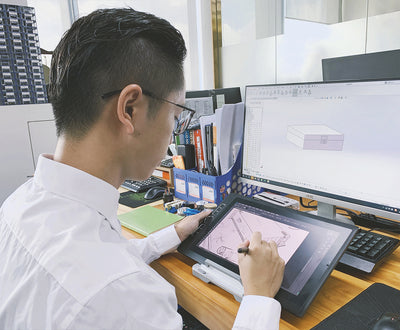
Transitioning from a digital CAD file to a physical, market-ready panel can be incredibly frustrating if you rely on multiple vendors for cutting, finishing, and printing. Any misalignment between the milled hole and the printed text instantly ruins the product's professional appearance.

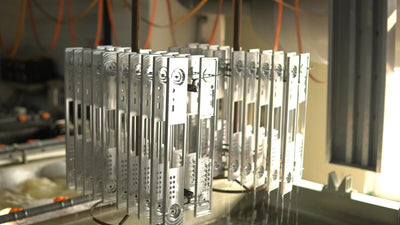
This is where YONGU fundamentally streamlines aluminum front panel manufacturing. By providing comprehensive, end-to-end fabrication services, YONGU eliminates integration friction. When developing a custom 19 inch front panel, designers simply upload their DWG, DXF, or STEP files. YONGU’s multi-axis CNC machines mill the exact I/O layouts. But the true advantage lies in their unified finishing process. YONGU handles high-end surface treatments—such as premium sandblasting and anodic oxidation—creating a scratch-resistant, hardened exterior. Furthermore, they offer precision UV printing, silk-screening, and laser engraving perfectly calibrated to the CNC toolpaths. Your panel arrives with the volume dials, warning labels, and your corporate logo printed flawlessly above the perfectly milled ports, instantly elevating your hardware to a premium tier.
Material and Fabrication Comparison for Rack Panels
Understanding why aluminum dominates the 19-inch rack industry requires looking at the data. Below is a comparison of standard front panel materials used in industrial and IT infrastructure:
| Material Specification | Extruded / Billet Aluminum (YONGU) | Cold Rolled Steel | Acrylic / Polycarbonate |
|---|---|---|---|
| CNC Machinability | Exceptional (Allows for smooth, blind tapped holes and chamfers) | Moderate (Harder on tooling, limited 3D profiling) | Good (But prone to cracking around mounting ears) |
| Structural Rigidity for Rack Mounting | High (Withstands heavy internal chassis weight without bending) | Very High (Ideal for extreme heavy-duty servers) | Poor (Will sag or snap under equipment load) |
| Surface Finishing & Aesthetics | Premium (Supports anodizing, brushing, and UV printing) | Basic (Requires powder coating or painting to prevent rust) | Consumer (Scratches easily, cannot dissipate heat) |
| Corrosion Resistance | Superior (Natural oxide layer prevents rusting) | Low (Scratches lead directly to red rust) | High |
Frequently Asked Questions (FAQ)
Q1: What does "19-inch" and "U" actually mean in rack panels?
A: The "19-inch" dimension refers to the standardized overall width of the front panel, designed to fit standard EIA-310 server and audio racks. The height is measured in Rack Units (U or RU), where 1U equals precisely 1.75 inches (44.45mm). A custom 2U panel would therefore be exactly 3.5 inches tall.
Q2: What CAD file formats do I need to supply for CNC manufacturing?
A: To ensure absolute precision, manufacturers require vector-based or 3D files. Standard acceptable formats include .DWG or .DXF for 2D hole layouts, and .STEP or .IGES files if your panel requires complex 3D features like recessed countersinks or blind standoffs.
Q3: Does the anodizing process affect the dimensions of my cutouts?
A: Yes, but only on a microscopic scale. Standard anodic oxidation adds a layer of a few micrometers. While negligible for most components, a professional CNC manufacturer accounts for this micro-growth during the milling stage to ensure extremely tight-tolerance components, like press-fit light pipes, still fit perfectly after finishing.
Give Your Hardware the Professional Interface It Deserves
Stop compromising your advanced electronics with generic, hand-modified faceplates. Ensure perfect alignment, flawless structural integrity, and world-class branding with a custom-machined aluminum front panel.