English
 العربية
 Nederlands
 Français
 Deutsch
 Italiano
 日本語
日本語 한국어
한국어 Polski
 Português
 Русский
 Español




The absolute foundation of delivering pristine, zero-latency sound in any professional recording or mastering environment goes far beyond the internal circuitry—it fundamentally relies on the physical housing of the equipment. Housing sensitive preamplifiers, analog-to-digital converters, and heavy DSPs within a specialized, thermally optimized, and electromagnetically shielded aluminum 19-inch rack-mount chassis actively prevents signal degradation. By neutralizing radio-frequency interference, eliminating microphonic resonance, and acting as a massive passive heat sink, a professionally engineered enclosure guarantees pure audio fidelity while extending the operational lifespan of expensive studio hardware.

The Hidden Enemies of Broadcast Audio Quality
Sound engineers and broadcast studio managers operate in highly unforgiving technical environments. A standard server rack in a data center only needs to keep networking gear cool, but a studio rack must preserve the absolute purity of a low-voltage analog audio signal. When designing or integrating custom audio gear, builders face three invisible threats that can instantly ruin a tracking session: electromagnetic interference (EMI), mechanical vibration, and thermal throttling.
Modern recording studios and live broadcast control rooms are heavily saturated with electronic noise. Dozens of intertwined XLR cables, power conditioners, Wi-Fi routers, wireless microphone receivers, and high-frequency digital clocks create a chaotic storm of radio-frequency interference (RFI) and EMI. If a compressor or EQ unit is housed in a cheap, unshielded plastic or thin steel box, it essentially acts as an antenna for this noise. This interference manifests as an audible 60Hz hum, high-frequency hiss, or erratic clicking in the audio master track. Achieving total sonic isolation requires a broadcast studio rack enclosure engineered specifically to act as a seamless Faraday cage.
Mechanical Resonance and Microphonics
Beyond electrical noise, audio hardware is uniquely sensitive to physical vibration. In live sound venues or studios with large subwoofers, low-frequency soundwaves physically rattle equipment racks. If a chassis is flimsy, these vibrations transfer directly to the internal PCBs. For analog gear utilizing vacuum tubes, large capacitors, or sensitive relays, this vibration can induce "microphonics"—where the mechanical rattling is translated back into the audio path as distortion.
Furthermore, professional audio power supplies often utilize massive toroidal transformers. These transformers are incredibly heavy. If an enclosure lacks structural rigidity, the immense weight concentrated on one side of the chassis can cause "rack sag," bending the front panel and damaging the rack rails. Therefore, utilizing a heavy-duty extruded audio processing rack chassis is non-negotiable for keeping heavy components stable and mechanically isolated.
Thermal Management for Silent Recording Spaces
Heat is the silent killer of electronic components, but managing heat in a studio environment presents a unique paradox. In a standard IT environment, you simply add high-RPM cooling fans to blast hot air out of the case. In a live recording room or a mastering suite, mechanical fan noise is completely unacceptable. The acoustic whine of a 40mm or 80mm fan bleeds into condenser microphones and fatigues the mastering engineer's ears.
Audio hardware must be cooled silently. Extruded aluminum is the material of choice for the industry's most high-end gear because it boasts a phenomenal thermal conductivity rate. Instead of trapping heat, an aluminum chassis absorbs the thermal output from Class-A amplifiers and voltage regulators, dissipating it naturally across the exterior surface area. This passive convection cooling allows high-end studio gear to run completely fanless.
Bridging High-End Audio Design with Seamless Integration
Transitioning an incredible circuit design into a commercial piece of studio gear often hits a major bottleneck during chassis integration. Attempting to manually drill precise holes for heavy-duty Neutrik XLR jacks, dual-concentric potentiometers, and custom VU meters is frustrating. Hand-modified cases often suffer from misaligned knobs, sharp burrs, and scratched finishes that look amateurish in a world-class studio rack.
To eliminate these hardware integration hurdles, custom audio builders and OEM equipment designers partner directly with YONGU. When sourcing a premium 19 inch rack case audio engineers can rely on YONGU's dedicated modular server and rack solutions, such as their customizable 19-inch 2U rack series.

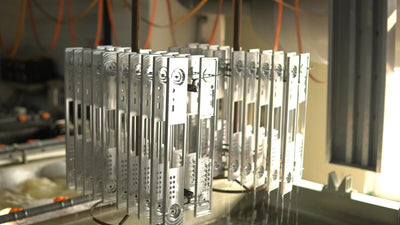
Because the 2U form factor offers 3.5 inches of internal height, it easily accommodates upright transformers, full-sized discrete op-amps, and large cooling fins required by boutique analog gear. YONGU streamlines your manufacturing process by providing in-house micro-precision CNC machining. By submitting your exact CAD layout, your chassis arrives with every single knob, toggle switch, and I/O port perfectly milled. Combined with high-end surface treatments—such as premium sandblasting, black anodic oxidation, and precise laser engraving for your brand logo—YONGU ensures your hardware not only sounds flawless but looks indistinguishable from legendary legacy studio equipment.
Material Comparison for Studio Rack Equipment
To help audio designers and studio technicians select the best enclosure for their next build, the following table compares common materials based on critical audio performance metrics:
| Performance Metric | Extruded Aluminum (Industry Standard) | Cold Rolled Steel | Polycarbonate / Plastic (Budget) |
|---|---|---|---|
| EMI/RFI Shielding | Exceptional (Creates a perfect Faraday cage) | High (Particularly against magnetic fields) | None (Leaves audio paths vulnerable to hum) |
| Thermal Management | Superior (Enables silent, fanless passive cooling) | Poor (Traps heat, requires noisy fans) | Very Poor (Acts as a thermal blanket) |
| Vibration Dampening | High (Rigid walls resist microphonic rattling) | Moderate (Can "ring" if panels are thin) | Low (Can crack under heavy transformers) |
| Aesthetic & Finish | Premium (Supports anodizing and laser etching) | Utilitarian (Prone to scratching and rust) | Consumer-grade |
| Machinability for Custom I/O | Excellent (Clean, precise cuts for XLR/TRS jacks) | Moderate (Requires tougher tooling) | Good (But looks unprofessional) |
Frequently Asked Questions (FAQ)
Q1: Why is a 2U rack case often preferred over a 1U case for audio processing?
A: Audio equipment, particularly analog gear, requires large internal components to preserve signal headroom. High-end audio transformers, large capacitors, and discrete internal preamps simply will not fit in the 1.75-inch height of a 1U box. A 2U chassis provides adequate spatial clearance and drastically improves internal airflow to prevent overheating.
Q2: Will an aluminum rack case stop 60Hz ground hum?
A: Aluminum acts as a highly effective shield against airborne EMI and RFI, which heavily contributes to noise. However, to eliminate ground loops entirely, you must also ensure your internal PCB grounding scheme is properly tied to the chassis ground through a star-grounding point, which a metal chassis securely facilitates.
Q3: Can I get the front panel customized with specific text for my input channels?
A: Absolutely. Working with an OEM manufacturer allows you to fully customize the aluminum front panel. CNC milling is used to cut the exact holes for your potentiometers, while silk-screening or laser engraving applies permanent, high-contrast text for your specific channel labels, EQ frequencies, and brand logo.
Ready to House Your Masterpiece?
Do not let a poorly designed enclosure compromise your pristine audio circuitry. Give your broadcast and processing equipment the aesthetic prestige, thermal stability, and electrical silence it demands with a precision-machined, customized aluminum chassis.