English
 العربية
 Nederlands
 Français
 Deutsch
 Italiano
 日本語
 한국어
 Polski
 Português
 Русский
 Español





Anodizing turns a machined aluminum enclosure into a finished product — but it is also a chemical process with hard limits on sealing, grounding and dimensional fit. This guide covers the process step by step, the three MIL-A-8625 types, color options, thickness versus corrosion, and the two places anodizing quietly causes problems in IP65/IP68 designs. For the parts themselves, browse the surface treatment service and the anodized aluminum enclosure H01.

What Is Aluminum Anodizing?
Anodizing converts the aluminum surface into a hard, tightly bonded layer of aluminum oxide. The part is the anode in an electrolytic cell — hence "anodizing" — and the oxide grows out of the metal rather than being deposited on it. It is not a paint-like coating: it is part of the metal, with a controlled micro-porous structure that can be dyed and sealed.
That structure is why anodizing works on enclosures: the oxide is electrically insulating, harder than the base metal and dimensionally stable — it does not peel or blister like paint — and it holds dye in its pores, which is how anodized aluminum gets its color. The governing specifications are MIL-A-8625F (the U.S. industry reference for Types I/II/III) and ISO 7599:2018 (decorative and protective coatings), both defining thickness classes and sealing quality.
The Anodizing Process Step by Step
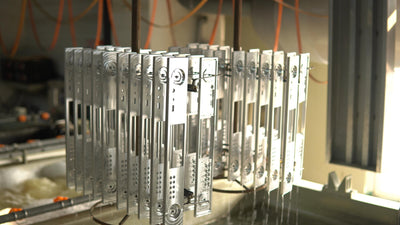
A production anodizing line runs six stages, and each stage determines a different property of the finished enclosure:
1. Pre-treatment. Degreasing removes oils and coolant; alkaline etching normalizes the surface; desmutting (acid dip) removes alloying smuts so oxide grows evenly. Most cosmetic defects originate here: a scratch or weld smut becomes a visible streak after anodizing.
2. Anodizing. The racked part is immersed in sulfuric acid (15–20% at 18–22°C) as the anode. A DC current of 1–2 A/dm² grows oxide at about 0.3–0.5 μm per minute, so 10 μm takes 20–30 minutes. Bath temperature matters: cooler gives a harder, denser film; warmer a softer, more dyeable one.

3. Dyeing. The freshly anodized film is porous and absorbs organic dye readily. Color depth depends on dye concentration, temperature and immersion time; the same dye lot on another alloy will not match exactly, so color is approved on production samples, not color chips.
4. Sealing. The pores are closed by boiling-water sealing or cold nickel-acetate sealing. Sealing determines corrosion resistance and dye fastness — an unsealed film looks fine and fails in salt spray. ISO 7599 defines the sealing-quality test used to verify it.
5. Inspection and packing. Coating thickness (eddy-current gauge), sealing quality, color match under a standard light box, and appearance are checked before packing. Thickness is usually specified as a range with a ±20% tolerance per MIL-A-8625.
Types of Anodizing (Type I/II/III)
MIL-A-8625 defines three types by electrolyte and application, and each type has a class for dyed (Class 2) or undyed (Class 1) finish:
| Type | Electrolyte | Typical thickness | Best for |
| Type I | Chromic acid | 0.5–17.8 μm (0.02–0.7 mil) | Aerospace, fatigue-sensitive parts, thin films |
| Type II | Sulfuric acid | 5–25 μm (0.2–1.0 mil) | Enclosures, decorative + protective, dyeable |
| Type III | Sulfuric (hardcoat) | 25–50 μm (1.0–2.0 mil) | Wear resistance, abrasion, heavy-duty panels |
Ranges are typical values within MIL-A-8625 classes; the spec's default Type II nominal is 2 mil (50.8 μm) unless the drawing or PO states otherwise — so always put thickness on the drawing.
Type II: Standard Sulfuric Acid
Type II is the workhorse of the enclosure industry. It gives a clean, uniform film, accepts the full dye range, and costs a fraction of hardcoat. For electronic enclosures it is specified at 10–20 μm — thick enough for color depth and corrosion protection, thin enough to preserve thread engagement and sealing geometry. Type II Class 1 is natural (clear/silver); Class 2 is dyed. Almost every colored aluminum enclosure you see — black, champagne, bronze, blue — is Type II Class 2.
Type III: Hardcoat
Hardcoat (Type III) uses a colder, more acidic bath and higher current density to build a much denser, harder film, typically 25–50 μm. It is specified where the surface takes real abrasion: military housings, industrial control panels, sliding surfaces, and enclosures that see repeated handling or cleaning. Two practical cautions: hardcoat darkens the base color (bronze-gray) and limits dye options, and the thicker film grows dimensions by 25–50 μm per side — which matters on precision mating faces.
Color Options & Dyeing
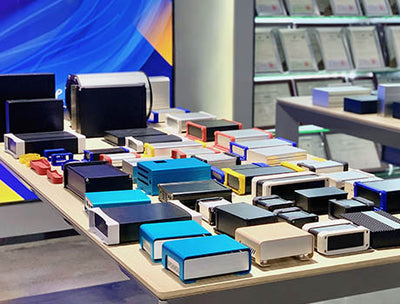
Anodized color comes from organic dyes absorbed into the porous film before sealing. The practical range for enclosures is wide and stable, but it is not a paint-matching system — colors are approved on physical samples under defined lighting, and adjacent production lots can differ slightly. The table below shows the common enclosure palette with its appearance:
| Finish | Swatch | Appearance | Typical use |
| Natural / Clear | Silver metallic, shows grain | Instrument, lab, medical | |
| Matte Black | Deep black, low reflection | Audio, broadcast, server | |
| Champagne Gold | Warm metallic gold | Hi-Fi, premium instruments | |
| Bronze / Titanium | Dark brown-gray metallic | Industrial, outdoor, rugged | |
| Deep Blue | Dark navy metallic | Control, measurement equipment | |
| Wine Red | Deep red metallic | Branded products, audio |

Swatches indicate the finish family, not exact production color — anodized color shifts with alloy, temper, film thickness and lighting, so approve a physical sample. Base texture matters too: brushing leaves directional lines, while sandblasting produces a uniform matte that hides fingerprints and machining marks — the usual pre-anodize texture on enclosures. The high-gloss surface treatment guide covers texture options.
Anodizing Thickness & Corrosion Resistance
Thickness is the main lever for corrosion life, and it is also the main dimensional variable. The table below pairs thickness with what it buys and where it is typically used on an enclosure:
| Coating | Thickness (μm / mil) | Corrosion & wear | Enclosure use |
| Thin Type II | 5–10 / 0.2–0.4 | Indoor protection, good dye | Indoor instrument, consumer |
| Standard Type II | 10–20 / 0.4–0.8 | Balanced; 200–1000 h NSS typical | Rack, audio, industrial panels |
| Heavy Type II | 20–25 / 0.8–1.0 | Better salt-spray and dye depth | Outdoor, coastal, IP65 housings |
| Hardcoat Type III | 25–50 / 1.0–2.0 | Abrasion-resistant, long salt-spray | Rugged, industrial, IP68 outdoor |
Salt-spray hours are a property of the whole system — alloy, film thickness, sealing quality and dye — not of thickness alone. A sealed 20 μm Type II film on 6063 commonly reaches several hundred hours of neutral salt spray, while the same thickness badly sealed can fail early. Specify the test method and acceptance criterion (for example, ASTM B117 with no white corrosion at 500 h) on the drawing, and ask for the test report rather than relying on a generic claim.
Anodized Finishes for Enclosures
On a finished enclosure, the anodized film does three jobs: it protects the surface, it carries the brand color, and — unintentionally — it insulates. That third job is where enclosure engineering gets interesting.
Threads and mating faces. A 20 μm film on each side of a joint adds roughly 40 μm to the fit — enough to change a sealed joint or a tight thread. Enclosures needing precision mask critical faces, anodize before final machining, or specify a thinner film; threads are masked or chased after coating.
Sealing and IP65/IP68. Anodizing adds corrosion resistance but does nothing for water ingress — the gasket and groove do that. On IP65 and IP68 housings, groove faces are masked or machined after coating so the gasket seats on bare aluminum. Thick oxide in a groove can crack under gasket load and create a leak path — a failure that appears only in immersion testing.
Grounding and EMI. Anodized aluminum is an insulator — high surface resistance, no galvanic path. If the enclosure carries shield or earth current, grounding points must be masked before anodizing (or stripped locally), with a conductive gasket or bonding strap at the joint. It is the most frequently missed detail in anodized enclosure specs, and a standard DFM check in YONGU's design service.
Typical anodized enclosures in the catalog show the range: the anodized D-series rack chassis, the 2U anodized rack enclosure and the compact H01 anodized housing.
Anodizing vs Powder Coating
Both finishes color and protect aluminum, but they are different products for different jobs:
| Property | Anodizing (Type II) | Powder coating |
| Film thickness | 10–20 μm, integral to metal | 60–120 μm, applied film |
| Appearance | Metallic, shows grain; deep color | Opaque, matte/satin; any RAL color |
| Abrasion | Hard oxide, scratch-resistant | Softer, chips at edges/impact |
| Corrosion | Excellent, sealed film | Excellent if film intact; rust at scratches |
| UV / weather | Stable, no chalking | Good with exterior-grade powder |
| Color range | Limited dye palette, metallic only | Full RAL, any solid color |
| Dimensional impact | +10–20 μm per side | +60–120 μm, masking needed |
The practical rule: anodize when the metal look, hardness and thin film matter (audio, instruments, rack gear, precision fits); powder coat when you need an exact opaque color, a thicker protective film, or a matte finish that hides surface imperfections. Many enclosure programs use both — anodized panels, powder-coated frame. The rackmount case surface treatment method compares the full finishing menu, and the aluminum alloy anodizing process article covers the chemistry in more depth.
Get an Anodized Color Card & Physical Sample
Tell us your alloy, target thickness (10/15/20 μm), texture (sandblasted or brushed) and color reference — we send the color card, a real anodized sample and a production quote within 1 working day.
Samples 8–10 days · batch 15–30 days · US delivery via DHL/UPS/FedEx 7–15 days · no MOQ
FAQs
What is the difference between Type II and Type III anodizing?
Type II is standard sulfuric-acid anodizing, typically 5–25 μm, dyeable and used for most enclosures. Type III (hardcoat) uses a colder, more acidic bath and higher current density to produce a denser 25–50 μm film that resists abrasion — used on rugged housings and sliding surfaces. Hardcoat is darker and accepts fewer dye colors.
How thick should anodizing be on an aluminum enclosure?
For indoor electronic enclosures, 10–20 μm Type II is the practical range: enough for color depth and corrosion protection without disturbing threads or sealing geometry. Outdoor and coastal housings go to 20–25 μm sealed, and hardcoat 25–50 μm where abrasion is a concern.
Does anodizing improve corrosion resistance?
Yes, but it depends on the sealed film rather than thickness alone. A properly sealed 20 μm Type II coating on 6063 typically achieves several hundred hours of neutral salt spray (ASTM B117); a poorly sealed film of the same thickness can fail early. Specify the salt-spray hours and acceptance criterion on the drawing.
Can anodized aluminum be used for EMI shielding or grounding?
Not directly — the anodic oxide layer is an insulator. Enclosures that must carry ground or shield current need the grounding points masked before anodizing (or locally stripped), plus a conductive gasket or bonding strap at the joint. This is the most commonly missed detail in anodized enclosure specifications.
How does anodizing affect IP65 and IP68 sealing?
Anodizing protects the surface but does not seal it; the gasket and groove do that. Because the film grows 10–25 μm per side, sealing grooves are usually masked or machined after coating so the gasket seats on bare aluminum. A thick oxide layer in a groove can crack under gasket load and create a leak path.
Is anodizing better than powder coating for an aluminum enclosure?
They solve different problems. Anodizing gives a metallic look, a hard thin film and no chipping, but a limited dye palette and an insulating surface. Powder coating gives any opaque RAL color and a thicker film, but can chip at edges and needs masking. Many enclosures use anodized panels with powder-coated frames.
Can anodizing be done in any color?
The palette is broad — black, champagne, bronze, blue, red, gray — but not a paint-matching system. Color shifts with alloy, temper, film thickness and lighting, so colors are approved on physical samples under standard lighting, not digital swatches.