English
 العربية
 Nederlands
 Français
 Deutsch
 Italiano
 日本語
日本語 한국어
한국어 Polski
 Português
 Русский
 Español




An Aluminum Meter Electronic Case is a highly specialized protective housing—typically constructed from extruded 6063-T5 aluminum alloy—designed specifically for test, measurement, and laboratory instrumentation. Its primary functions are providing a robust Faraday cage for superior EMI/RFI shielding, acting as a passive heatsink for internal components (often utilizing ribbed side profiles), and offering rigid, rack-mountable structures for standardized equipment racks. Engineers favor these enclosures because the extrusion process allows for infinite length customization while maintaining a seamless structural integrity.

So, you’ve finally finished routing that high-speed mixed-signal PCB. The prototype works flawlessly on your anti-static mat. The noise floor is beautifully flat. Then, you decide to box it up in a cheap plastic enclosure you found in the storage closet, fire up the power supply, and—bam. Your high-precision DAQ is suddenly acting like a massive antenna, picking up the 50Hz mains hum and the local taxi dispatch radio.
EMI is a ruthless mistress, and thermal throttling is her equally annoying sister. This is exactly why you don't put serious measurement gear into plastic tupperware. You need metal.
The Physics Behind the Extrusion
But we aren't just talking about bending some cheap mild steel. There is a reason why almost every piece of high-end lab gear, from oscilloscopes to spectrum analyzers, lives inside an Aluminum Meter Electronic Case.

The magic usually starts with 6063-T5 aluminum alloy. As a hardware guy, you know this material is the golden child of the extrusion world. It hits the sweet spot between structural rigidity, excellent thermal conductivity (hovering around 200 W/m·K), and high machinability.
Take a look at the classic instrument case design—specifically those ribbed side panels. Those aren't there just to make the unit look aggressive and "military-grade." Those are built-in passive heatsinks. By increasing the surface area, the extruded profile allows for natural convection cooling, pulling heat away from your power regulators and high-current drivers without the acoustic noise of a cooling fan ruining your acoustic lab measurements.
The Prototyping Nightmare: Dremels, Files, and Tears
Let's address the elephant in the lab. We’ve all been there: holding a generic 19-inch rack chassis, staring at a blank, solid aluminum front panel, holding a hand drill, and praying to the hardware gods.

Cutting perfectly square windows for LCD displays, intricate D-sub connector slots, and perfectly aligned BNC matrix holes by hand is a miserable experience. You spend three hours with a Dremel, some needle files, and masking tape, and the end result still looks like it was chewed on by a mechanical dog. Scratched anodizing, misaligned mounting holes, and suddenly your $5,000 piece of custom hardware looks like a high school science fair project.
The Engineer's Cheat Code: Let YONGUCASE Handle the Dirty Work
Here is where you need to stop acting like a bench machinist and go back to being an electronic engineer. The easiest way to get your instrument looking professional and passing CE/FCC EMC testing without losing your mind is leveraging an ecosystem that does the heavy lifting for you.
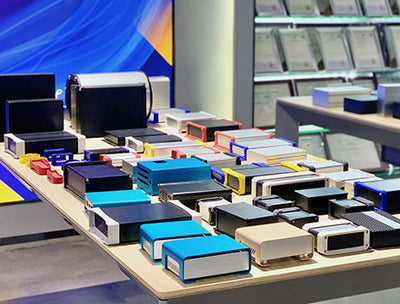
This is where YONGUCASE steps into the picture. Instead of designing a chassis from scratch and paying a mechanical shop five figures for tooling fees, you utilize their massive inventory of standard public molds. Need a sleek, black-anodized Aluminum Meter Electronic Case with standard 19-inch rack-mount ears? They have standard widths (like the classic 437mm internal rack clearance) ready to go.
But the real trick up their sleeve—and the reason it saves you weeks of iteration—is their secondary processing. Because these are extruded profiles, Yongucase can slice the depth to your exact PCB dimensions. No more standard 250mm or 300mm compromises. If your board needs 273mm of clearance, you get 273mm.

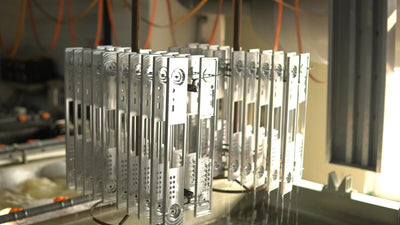
More importantly, you just hand them your CAD file. Their high-speed CNC centers will mill out your precise I/O layout with ±0.1mm tolerances. Throw in a premium #120 grit sandblasting, a deep black anodic oxidation treatment to prevent oxidation, and a custom silkscreen for your logo and port labels, and your prototype suddenly looks identical to a mass-produced unit off a Tier-1 assembly line.
You focus on the firmware and the circuit topology. Let them handle the aluminum shavings.
Frequently Asked Questions (FAQ)
Q: What makes 6063 aluminum better for electronic cases than standard sheet metal?
A: 6063 aluminum is highly extrudable, allowing for complex geometries like integrated PCB guide rails and external heat-dissipating fins to be formed in one solid piece. It also provides superior thermal conductivity and is lighter than steel while maintaining excellent EMI/RFI shielding characteristics.
Q: Can the depth of an Aluminum Meter Electronic Case be customized?
A: Yes. Because the main body of these cases is made from an extruded aluminum profile, YONGGU can cut the extrusion to any specific length your project requires, meaning you aren't forced into standard "off-the-shelf" depths.
Q: How does secondary CNC machining work with standard enclosures?
A: Instead of buying a blank enclosure and machining it yourself, you select a standard public mold from YONGGU to save tooling costs. You then provide a DXF or step file of your port layout. YONGGU's factory uses CNC milling to cut the exact holes, slots, and recesses required before final surface treatments (like anodizing) are applied, ensuring clean edges with no raw aluminum exposed.
Q: Are these enclosures suitable for standard 19-inch equipment racks?
A: Yes, many meter and instrument cases are designed with widths accommodating standard server/telecom racks (e.g., ~437mm without ears), and often feature integrated or attachable flanged ears to mount directly onto rack rails.