English
 العربية
 Nederlands
 Français
 Deutsch
 Italiano
 日本語
日本語 한국어
한국어 Polski
 Português
 Русский
 Español




Modern industrial control systems, edge computing hubs, and telecommunication networks hinge on one foundational element to survive hostile environments: precisely engineered hardware housing. Ensuring equipment stability, efficient thermal dissipation, and seamless scalability requires deploying standardized physical architectures that eliminate mechanical stress, prevent electromagnetic interference (EMI), and streamline maintenance operations. Ultimately, the survival and uninterrupted efficiency of high-stakes industrial electronics are dictated by the structural integrity of the metal framework that surrounds them.

Addressing the Hidden Pain Points in Industrial Infrastructure
Deploying sensitive electronics in demanding geographic and industrial environments involves navigating a minefield of physical and environmental threats. Engineers, system integrators, and IT managers constantly grapple with several critical pain points that, if ignored, can lead to catastrophic hardware failure, delayed project timelines, and costly system downtime.
1. The Thermal Management Dilemma
One of the most persistent challenges in industrial system integration is balancing space optimization with effective heat dissipation. As processing power increases for edge computing and industrial automation, electronic components generate unprecedented levels of heat. In cramped factory floors or dense server rooms, inadequate airflow can degrade PCB lifespans and trigger severe thermal throttling. A poorly designed housing traps heat, creating a localized oven for your sensitive networking or computing gear. In high-power industrial setups, passive cooling alone is rarely enough, but the material of the housing plays a huge role. Engineers need enclosures built from materials like high-grade extruded aluminum, which inherently possesses excellent thermal conductivity. This acts as a massive passive heat dissipater, reducing the overall cooling burden on internal fans and heat sinks.
2. Mechanical Vibration and Environmental Shock
Unlike controlled, pristine enterprise data centers, industrial environments—such as manufacturing plants, transit hubs, railway systems, or energy substations—expose electronics to relentless mechanical vibration and physical impacts. Constant micro-vibrations can loosen standard chassis screws, disrupt delicate PCB solder joints, and cause premature hard drive failures. Equipment must be anchored securely within an industrial rack case that boasts superior material thickness and structural rigidity to absorb and deflect these kinetic forces. Specialized internal supports and robust outer panels become the first line of defense, ensuring that high-value electronics operate uninterrupted despite external physical trauma.
3. The Complexity of Global Compatibility and Scaling
When technology companies scale operations globally, hardware fragmentation becomes a logistical nightmare. Custom, proprietary box sizes lead to massive headaches during upgrades, part replacements, or rapid network expansions across different countries. System integrators need absolute assurance that a server or control unit built in Europe will perfectly fit into a telecom rack deployed in Asia or North America. This is why strict adherence to the universal rackmount chassis standard (such as the EIA-310 specification) is non-negotiable. Standardized widths and precise hole alignments guarantee that any new hardware addition can be rapidly deployed, swapped, or scaled without overhauling the existing physical infrastructure.

Applying Reliable Housings in Real-World Scenarios
Bridging the gap between vulnerable electronic components and a harsh industrial reality requires smart, adaptable engineering. High-quality construction and modular internal designs offer a seamless integration path for diverse and demanding industrial applications.
Consider a security control center, a smart-grid substation, or an automated factory floor relying on real-time data processing. The networking switches, power distribution hubs, and control servers driving these operations can be safely housed in a highly versatile 19 inch rack enclosure. By utilizing YONGU’s premium 1U configurations (measuring exactly 486.2mm x 44.45mm x 200mm, with scalable depths available), integrators gain immediate access to a housing solution designed for extreme reliability. The 3mm, 5mm, or even 8mm thickness of the aluminum front interface panel offers exceptional defense against physical impacts, all while providing an elegant, professional aesthetic that enhances the perceived value of your final deployed product.
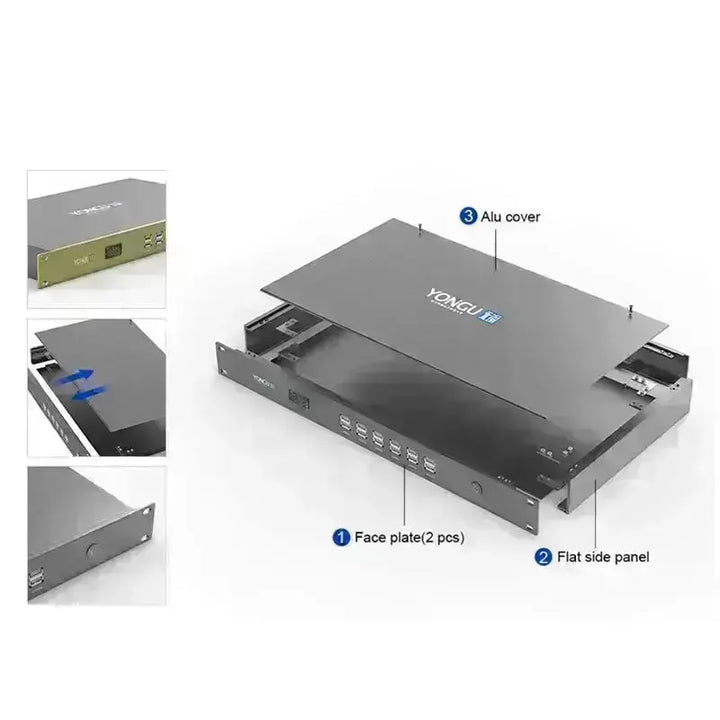
Moreover, YONGU’s product engineering directly addresses the daily frustrations of internal assembly and customization. With front and rear internal supports specifically designed for the secure mounting of internal trays, OLED displays, intricate cable management systems, and delicate PCBs, these enclosures allow engineers to build highly specialized industrial tools without worrying about structural instability. The assembly is secured utilizing precisely tapped M3 inner fixed screws (including robust L-type brackets utilizing up to 20 screws to maximize stability), creating a rigid frame that effortlessly withstands both global shipping transit and rigorous on-site vibrations.
Because every industrial project has unique geographic and technical requirements, off-the-shelf solutions often fall short. YONGU excels by offering an end-to-end custom-to-delivery process with strictly no Minimum Order Quantity (MOQ). Whether you need precise CNC cutouts for custom ethernet and USB I/O panels, unique color anodizing (like Sapphire Blue, Champagne Gold, or Matte Black) for corporate branding, or silkscreen/laser-printed operational instructions directly on the panel, the standard chassis can be tailored perfectly to your project’s specifications. By bridging standardized external dimensions with infinite internal flexibility, YONGU ensures your hardware meets both global compliance and hyper-specific operational needs seamlessly.
Standardization Data: Optimizing Your Rack Space
To ensure maximum compatibility and space utilization, it is crucial to understand how different enclosure heights impact your system capabilities. Below is a comprehensive reference table outlining the standard dimensions and their most suitable industrial applications.
| Rack Unit (U) | Standard Height (mm / inches) | Standard Width | Typical YONGU Depth Options | Ideal Industrial Applications |
|---|---|---|---|---|
| 1U | 44.45mm / 1.75" | 19 inches (482.6mm) | 200mm / 250mm / 270mm | Networking switches, thin edge servers, security control interfaces, signal amplifiers. |
| 2U | 88.90mm / 3.50" | 19 inches (482.6mm) | 250mm / 300mm / 324mm | Data center storage, advanced power supplies, AV matrix switchers, industrial PCs. |
| 3U | 133.35mm / 5.25" | 19 inches (482.6mm) | 250mm / 300mm / 324mm | Complex medical device enclosures, battery backup systems, heavy-duty processing arrays. |
| 4U | 177.80mm / 7.00" | 19 inches (482.6mm) | 250mm / 300mm / 324mm | High-performance computing (HPC), multi-GPU setups, massive database storage arrays. |
Frequently Asked Questions (FAQ)
What exactly is a 19 inch rack enclosure?
It is a standardized equipment housing framework used primarily for mounting multiple electronic equipment modules. The 19-inch (482.6mm) measurement refers to the total width of the front panel, including the mounting 'ears'. This universal standard allows equipment from various manufacturers to fit seamlessly into the same physical telecom or server rack, maximizing space and organizational efficiency across different global regions.
Why is adhering to a rackmount chassis standard important for my project?
Following a globally recognized standard (such as EIA-310) ensures that your hardware is universally compatible. This standard defines precise specifications for the width, vertical hole spacing, and height (measured in Rack Units or "U"). Adhering to this ensures you can seamlessly install, swap, and scale your systems in any standard facility worldwide without requiring custom mounting brackets.
Can I customize an industrial rack case without a massive minimum order?
Yes. Advanced manufacturers provide extensive customization—including precise CNC cutouts, custom color anodizing, custom depths, and logo printing—with absolutely no Minimum Order Quantity (MOQ) limits. Whether you need a single functional prototype for testing or a massive batch of thousands for a full deployment, you can receive a perfectly tailored product for your application.
Future-Proof Your Infrastructure Today
Securing your mission-critical electronics against the extreme rigors of industrial environments shouldn't be left to chance or guesswork. Whether you are building advanced networking gear, resilient edge computing servers, or complex safety controls, YONGU provides the precision-engineered solutions you need to succeed. Don't compromise on durability, thermal efficiency, or aesthetics. Contact us today to discuss your specific requirements, submit your engineering drawings, and let our expert team design the perfect customized enclosure for your next big project.