English
 العربية
 Nederlands
 Français
 Deutsch
 Italiano
 日本語
日本語 한국어
한국어 Polski
 Português
 Русский
 Español




Spectrum Analyzer Aluminum Chassis:Three Critical Pain Points in Spectrum Analyzer R&D and Application

1. High-Frequency Signal Interference and EMC Shielding Failure
As precision instruments for measuring RF and microwave signals, spectrum analyzers are extremely sensitive to electromagnetic interference (EMI). If the electromagnetic compatibility (EMC) design of the chassis is substandard, or if gaps between panels exceed 1/20 of the high-frequency wavelength due to poor manufacturing tolerances, RF leakage occurs. This raises the noise floor, drowning out weak signals and causing the product to fail strict compliance certifications in military and telecommunications sectors.
2. Thermal Accumulation Leading to Component Drift
High-speed FPGA chips and wideband RF front-ends generate significant heat during continuous sampling. Traditional sheet metal or plastic enclosures have low thermal conductivity, leading to heat buildup inside the cavity. This high-temperature environment triggers frequency drift in crystal oscillators, severely compromising measurement accuracy and the lifespan of internal sensitive components.
3. High Costs and Long Lead Times for Small Batch Customization
Startups and research institutions often require small batches for prototyping and iterative testing. Many suppliers impose high tooling fees for non-standard spectrum analyzer aluminum chassis, combined with chaotic production schedules that result in lead times of several weeks, significantly delaying the R&D cycle.
Deep Analysis: Why Generic Enclosures Fail Precision Instruments?
The root cause of these pain points lies in the disconnect between design and manufacturing. Generic die-cast or bent sheet metal cases often sacrifice performance for cost—using thinner walls that reduce structural rigidity and heat capacity. Furthermore, standard powder coating is non-conductive; applying it to contact surfaces breaks the electrical continuity required for a "Faraday Cage," essentially rendering high-level EMC shielding ineffective.
Yonggu Solution: High-Performance Spectrum Analyzer Aluminum Chassis
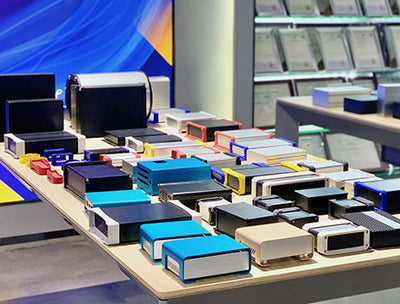
To meet the rigorous demands of RF instrumentation, Yonggu utilizes over 160 units of high-precision CNC equipment to provide solutions ranging from structural design to flexible manufacturing.
• Superior Thermal Management: We use 6063-T5 and 5052-H32 aluminum alloys. Specifically, 6063-T5 offers a thermal conductivity of 201 W/(m·K). Our A-Series (heatsink side-plate) chassis design utilizes integrated cooling fins to dissipate heat passively, eliminating the need for noisy fans while preventing frequency drift.
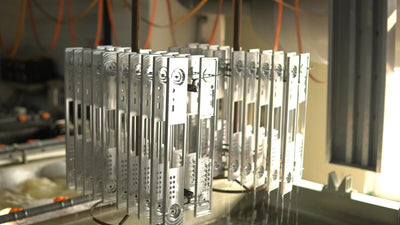
• Precision CNC & EMC Protection: We maintain CNC machining tolerances within +/-0.01mm to ensure seamless panel fitting. By applying conductive oxidation to contact joints while using aesthetic anodizing for external surfaces, we create a fully closed RF-shielded cavity.
• Modular "Secondary Design" without Tooling Fees: Leveraging our digital operations, we support "Secondary Design Customization" based on standard models (such as the D-Series desktop chassis or C-Series 19-inch rackmount). We provide precise hole cutting and front panel customization, with design drawings ready in 30 minutes and samples shipped within 24 hours.
Performance Comparison: Yonggu Pro-Chassis vs. Generic Sheet Metal
| Feature | Yonggu Spectrum Analyzer Aluminum Chassis | Generic Sheet Metal Enclosure |
|---|---|---|
| Material & Conductivity | 6063-T5 Aluminum, 201 W/(m·K), integrated heatsinks | Carbon steel, ~45 W/(m·K), prone to heat buildup |
| Machining Precision | Digital CNC Machining, +/-0.01mm tolerance | Stamping/Bending, +/-0.2mm tolerance |
| EMC Shielding | Excellent (Conductive oxidation + tight tolerances) | Poor (Large gaps + insulating powder coating) |
| Lead Time (Custom) | 1 unit MOQ, 24-hour sampling, no tooling fees | 2-4 weeks sampling, high initial tooling costs |
Case Study: Custom RF Tester Chassis for a Research Institute
Project Background: A scientific instrument company needed a portable high-frequency tester chassis. Requirements included high RF interference resistance, stackable stability for lab use, and a small initial run of 50 units.

The Solution: We utilized our D09 Series (4824U400) as the base for a secondary design.
• Material & Process: Front and rear panels were CNC-machined from 5052-H32 aluminum to accommodate high-density SMA/BNC connectors and a touch interface.
• Surface Finish: A combination of "Brushed Moon-Silver" and "Sandblasted Jasper Blue" anodizing provided a premium industrial look while ensuring internal ground continuity.
• Functional Details: Anti-skid vibration-damping feet were added to isolate the device from lab micro-vibrations, and internal slots allowed for direct PCB mounting.
The client passed all EMC tests on the first attempt and successfully launched the product with significantly lower prototyping costs.
Spectrum Analyzer Aluminum Chassis FAQ
Q1: How do you secure irregular PCBs inside the chassis?
Our extruded aluminum profiles feature built-in slots for standard PCB thickness. For non-standard boards, we can CNC-machine precision stand-offs on the base plate or customize internal aluminum dividers to provide physical isolation and structural support.
Q2: Can your surface treatments withstand harsh industrial environments?
Yes. Our automated anodizing process creates a dense oxide layer that resists salt spray, humidity, and chemical corrosion. This has been proven effective in maritime communication and outdoor monitoring applications.
Q3: Do you provide branding for small batch orders?
Absolutely. Even for 1-unit prototype orders, we offer automated laser marking. This provides high-precision, permanent labeling for ports and logos that will not peel or fade like traditional stickers.
Expert Consultation & Customization
A world-class spectrum analyzer deserves a chassis that balances thermal efficiency, EMC shielding, and industrial aesthetics. At Yonggu, we transform your concepts into tangible products with our "30-minute design, 24-hour sampling" commitment. If you are developing a new RF project and need a high-performance spectrum analyzer aluminum chassis, contact our engineering team today for a free structural evaluation.