English
 العربية
 Nederlands
 Français
 Deutsch
 Italiano
 日本語
日本語 한국어
한국어 Polski
 Português
 Русский
 Español




Aluminum Telecom Equipment Subracks,As global communication infrastructures scale rapidly with the deployment of 5G, fiber optics, and advanced broadband systems, hardware reliability has become non-negotiable. At the heart of this hardware protection is the aluminum telecom equipment subrack. Serving as the structural foundation for sensitive communication hardware, these enclosures must balance thermal management, structural rigidity, and electromagnetic compatibility (EMC).

Overcoming Common Bottlenecks in Telecom Hardware Sourcing
Engineers and procurement managers frequently encounter critical pain points when sourcing enclosures for telecom systems. Standard sheet metal or poorly processed aluminum boxes often fail to meet the rigorous demands of modern communication networks, leading to system failures and inflated maintenance costs.
1. The Thermal Management Dilemma
High-density telecom equipment generates substantial heat. When subracks lack proper thermal conductivity or optimized dissipation structures (like heat sink fins), internal temperatures spike, reducing the lifespan of sensitive electronic components. Standard suppliers often lack the capability to extrude complex heat-dissipating profiles, leading to overheating in high-load scenarios.
2. EMI/EMC Shielding Vulnerabilities
In data centers and base stations, electromagnetic interference (EMI) is a severe threat to signal integrity. Inferior enclosures with improper surface treatments or inaccurate structural gaps fail to provide high-level EMC shielding. This results in signal degradation, which is unacceptable in critical communication nodes.
3. Supply Chain and Customization Inefficiencies
Small-batch customization is notoriously expensive and slow. Communication networks often require non-standard mounting configurations or specific port cutouts. Many manufacturers either refuse low-volume customized orders or require exorbitant mold fees, delaying R&D and time-to-market.
Standard and Custom Aluminum Telecom Equipment Subracks: Making the Right Choice

Choosing between an off-the-shelf solution and a customized enclosure depends on the specific project phase and deployment environment. Whether deploying standard 19-inch racks or specialized outdoor units, the material standard generally remains AL 6063-T5 or AL 5052-H32 for optimal strength-to-weight ratio.
| Feature | Standard Subracks (e.g., 19-inch C-Series) | Customized Subracks |
|---|---|---|
| Design Cycle | Immediate availability; ready for deployment. | Requires rapid prototyping (typically 24 hours to a few days). |
| Application | Standard data centers, server racks, server rooms. | Non-standard spaces, outdoor base stations, specific PCB layouts. |
| Cost Efficiency | Highly cost-effective with zero mold fees. | Higher initial design cost, but optimized for exact hardware geometry. |
| Integration | Standardized U-heights (1U, 2U, 3U, 4U). | Tailored mounting points, specialized I/O port CNC machining. |
Designed for Seamless Integration into Communication Networks

A high-quality aluminum telecom equipment subrack is specifically designed for seamless integration into communication networks. This means conforming to international dimensional standards (like the EIA-310 for 19-inch racks) while offering modular flexibility.
Precision is key here. To ensure that servers, routers, and switches slide in smoothly without binding, the CNC machining tolerance must be strictly controlled. Furthermore, the surface treatment—typically sandblasting and anodizing—must not only prevent oxidation in humid environments but also maintain electrical conductivity at specific grounding points to ensure the entire network rack is properly grounded against static and surges.
Yonggu's Precision Manufacturing Approach for Telecom Enclosures
To solve the inherent challenges of heat, EMI, and customization delays, Yonggu Enclosures (永锢壳体) provides an advanced manufacturing framework tailored for the telecom industry.
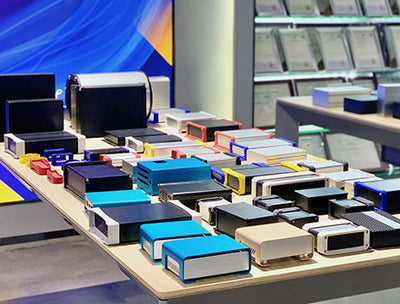
• Uncompromising Precision: Utilizing a 12,000-square-meter intelligent manufacturing base with over 160 fully digital CNC machines, we achieve machining tolerances of +/- 0.01mm. This guarantees that every standard and custom aluminum telecom equipment subrack fits perfectly into your server racks.
• Rapid Customization Protocol: We eliminate the "small-batch dilemma." Through our digitized supply chain, we offer a 30-minute secondary design service and 24-hour sample dispatch. Whether you need specific laser engraving for port identification or complex CNC cutouts for proprietary connectors, our flexible production line handles MOQ of 1.
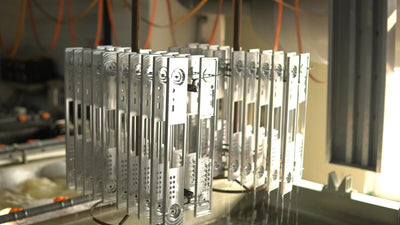
• Premium Material and Finish: Utilizing 6063-T5 extruded aluminum and 5052-H32 alloy plates, combined with automated sandblasting and anodizing lines, our enclosures deliver superior corrosion resistance and EMC performance, ensuring your equipment operates flawlessly in both indoor data centers and harsh outdoor telecom nodes.
Frequently Asked Questions (FAQ)
What are the benefits of using 6063-T5 aluminum for telecom subracks?
AL 6063-T5 offers excellent thermal conductivity, superior corrosion resistance, and high extrudability. This allows for the creation of complex cross-sections with built-in heat sink fins, making it ideal for passively cooling high-power telecom network equipment.
How do you handle EMC shielding requirements for high-frequency networks?
We ensure EMC compliance through precise CNC machining that minimizes panel gaps, combined with specific surface treatment strategies (such as conductive oxidation on mating surfaces and precise grounding point design) to form a continuous Faraday cage effect.
Can you accommodate specific form factors outside the 19-inch standard?
Yes. While our C-Series covers 19-inch standards perfectly, our industrial design and CNC capabilities allow us to manufacture completely non-standard enclosures designed for seamless integration into communication networks with unique spatial constraints.
Secure Your Telecom Infrastructure Today
The stability of a communication network begins with the physical integrity of its hardware. Do not let poorly constructed enclosures bottleneck your technological advancements. Contact our engineering team today to receive a comprehensive technical evaluation and a customized 3D structural proposal for your next aluminum telecom equipment subrack project.