English
 العربية
 Nederlands
 Français
 Deutsch
 Italiano
 日本語
日本語 한국어
한국어 Polski
 Português
 Русский
 Español




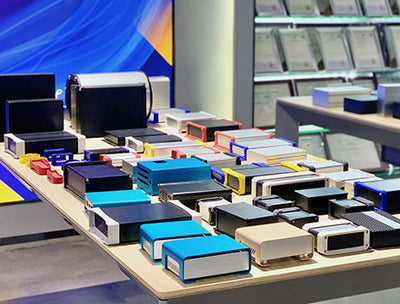
The performance of modern wireless communication systems hinges on the reliability of the Aluminum RF Power Amplifier Enclosure. As RF modules increase in power density, the requirements for electromagnetic compatibility (EMC) and heat dissipation become more stringent. A high-quality enclosure does more than just house components; it acts as a critical shield against electromagnetic interference (EMI) and a thermal bridge to maintain component longevity. At Yonggu Case , we leverage over 20 years of manufacturing expertise to provide precision-engineered aluminum solutions that meet the rigorous standards of the telecommunications and military sectors.

Critical Design Factors for an Aluminum RF Power Amplifier Enclosure
Designing an effective Aluminum RF Power Amplifier Enclosure requires a deep understanding of material properties and mechanical precision. RF power amplifiers generate significant heat and are highly sensitive to external noise. To address these challenges, the following factors are essential:
• Electromagnetic Shielding (EMC): Using materials like AL 5052-H32 ensures high conductivity, which is vital for creating a Faraday cage effect. Precision CNC machining at Yonggu ensures that joints and seams are tight enough to prevent signal leakage at high frequencies.
• Thermal Management: RF modules often operate at high temperatures. Our D-Series chassis(Industrial Electronic Desktop Rackmount Chassis) features integrated heat dissipation fins (radiating teeth) on the side panels, significantly increasing the surface area for passive cooling.

• Mechanical Durability: For outdoor or harsh environments, enclosures must withstand vibration and corrosion. Our L-Series and M-Series provide IP68-rated protection, utilizing 6063-T5 aluminum for its superior structural integrity and corrosion resistance.
Yonggu’s Advanced Manufacturing for RF Enclosures
As a leading one-stop enclosure solution provider, Yonggu Case operates a 12,000-square-meter intelligent manufacturing base equipped with over 160 digital CNC processing units. We don't just provide "off-the-shelf" quality; we provide data-backed precision.
| Technical Specification | Standard Capability | Yonggu Advantage |
|---|---|---|
| Material Selection | 6061 / 6063 / 5052 Aluminum | High-purity alloys for optimal signal-to-noise ratio |
| Machining Precision | ±0.1mm | High-speed CNC achieving ±0.05mm for RF cavity alignment |
| Surface Treatment | Standard Anodizing | Conductive oxidation, sandblasting (Starry Gray), and laser engraving |
| Prototyping Speed | 7-14 Days | JIT Digital production: 24-hour sample delivery |
For specialized RF applications, our industrial design center offers "30-minute secondary design" services, allowing customers to modify existing models like the D-Series (with machine feet) or G-Series (multi-functional) to fit specific PCB layouts and connector requirements.
Case Study: Custom Shielding Enclosure for Telecom Base Stations
A recent project involved the development of an Aluminum RF Power Amplifier Enclosure for a 5G infrastructure client. The requirement was a non-standard custom cavity with strict EMC leakage limits and a high-efficiency thermal path.
• Application: High-power signal amplification for outdoor base stations.
• Solution: We utilized the L-Series waterproof platform as a base, applying 5-axis CNC machining to create internal isolation chambers (cavities) for different RF stages. This prevented cross-talk between the driver and the final power stage.
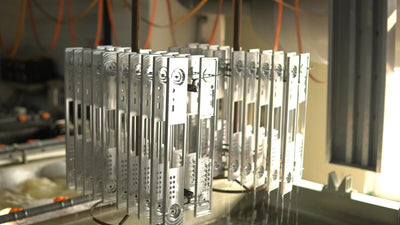
• Process: The enclosure underwent manual wire drawing, sandblasting (Jade Blue), and anodic oxidation to ensure a durable, non-conductive exterior while maintaining conductive contact points internally for grounding.
• Result: The client achieved a 15% reduction in operating temperature and met all FCC/CE EMC certification requirements on the first pass.
Frequently Asked Questions (FAQ)
1. Why is 6063-T5 aluminum preferred for an Aluminum RF Power Amplifier Enclosure?
6063-T5 offers an excellent balance of mechanical strength, corrosion resistance, and extrudability. It is ideal for complex shapes with integrated heat sinks, providing the structural stability needed for precision RF cavities.
2. How does Yonggu ensure EMC compliance in its enclosures?
We ensure compliance through precision CNC milling of mating surfaces to ensure metal-to-metal contact. We also offer conductive oxidation treatments and can integrate EMI gaskets or finger strips into the design to eliminate gaps.
3. Can I get a custom RF enclosure in small batches?
Yes. Yonggu specializes in "one-piece ordering" and flexible production. Our JIT (Just-In-Time) system is designed to handle both small-scale R&D prototypes and large-scale mass production without compromising on quality.
4. What surface treatments are best for RF shielding?
While standard anodizing is an insulator, we offer "Conductive Chromate Conversion" or selective masking during the anodizing process. This keeps the internal contact areas conductive for grounding while the exterior remains protected and aesthetically pleasing.
Consult with Yonggu for Your Next RF Project
Choosing the right Aluminum RF Power Amplifier Enclosure is a critical decision that impacts the performance and lifespan of your electronic systems. At Yonggu, we simplify the process: "You tell us your idea, and we deliver the product." Whether you need a standard 19-inch rack-mounted C-Series chassis or a fully bespoke CNC-machined shielding box, our team is available 365*24 to assist.
Contact our engineering team today for a free design review and quote. Experience the precision of "Good Case, Made by Yonggu."